Wednesday, September 07, 2011

Never Forget

By Capt. Fogg

This coming Sunday will be the 10th anniversary of the terrorist attack on Washington and New York and there's no way that anyone is going to forget it. After 10 years we're not only still mired in lachrymose and maudlin self-pity, but the incident has taken on a religious tone, complete with holy martyrs and holy relics. We still have cars with those plastic flag holders attached to the windows and we're reminded constantly that not only will we never forget, we'll never allow our grandchildren or their grandchildren to forget this dark day: the worst day in American history.

Of course I'll be condemned by some for hard heartedness, if not outright treason. I'm only arguing for a sense of proportion, but any balanced and reasonable viewpoint is so condemned in today's America. We're a radicalized, polarized nation choking and strangling on our own anger, yet cherishing it, nourishing it and hoping to preserve it in ritual, in perpetuity: a new anger for the ages. At least some powerful people hope that to be the case. Grieving people being so easy to manipulate and exploit, as some funeral directors know.


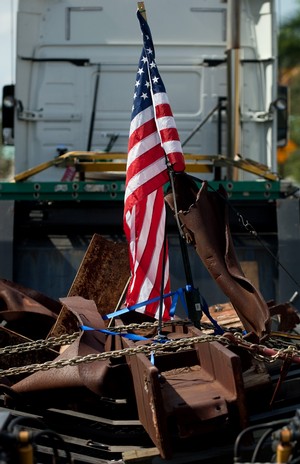
Some bits and pieces of the World Trade Center steel framework are being distributed to towns in my area. The Navy SEAL museum in Ft. Pierce now has a chunk and another arrived in my town a few days ago. The local paper printed photos of people kissing the rusty steel, touching their rosaries to it to make them extra holy and others simply hugging the metal, weeping.

The flag wrapped bits of steel arrived escorted by a motorcade over a quarter mile long. Military, law enforcement and veteran's motorcycle clubs accompanied it all the way south from the Georgia border like a funeral procession.
"Our objective is to eventually put this steel on every corner so that people never forget,"

said a retired New York homicide detective. That even includes my tiny, unincorporated crossroads town which has no other monuments of any kind. He expressed hope that one day there would be a holiday in every state honoring the policemen of New York. He promised never to forget.


Of course it wasn't all maudlin lamentation, there was plenty of anger still, even though bin Laden, most of his henchmen and all of those who perpetrated the attack are dead. Former detective Dennis McKenna promised that his son was soon going off to Afghanistan, where the perpetrators no longer dwell, to "whack one of them." Bagpipes were played, America the Beautiful was sung, Holy Water was poured on Holy Steel and then the bandwagon moved on.

"Let these pieces of steel remind us of the 2,973 men and woman who sacrificed their lives and, unknowingly, made our country and people become even stronger,"

said one Vietnam veteran. I wish it had done so, I wish all the other war memorials had made us more reluctant to make wars, but we're hardly stronger. We're far more divided, our economy has suffered from trillions of borrowed dollars turned to smoke. There is a bigger economic divide and the tear-shedders in their sackcloth and ashes want to sacrifice every bit of social progress since the 1860's, impoverishing the already debt-ridden majority while enriching the aristocracy.

Never forget that we're victims. Never remember how we victimized millions abroad in an uninvolved country. Always remember that "they" hate us and always complain when we attempt to make peace.

But how long will we actually remember and how long will we see this sad period in the same dim light? Surely half of our country no longer remembers 12/7/41 as the date that will live in infamy, nor the Battleship Maine on 2/15/98 or the burning and sacking of Washington DC on 8/24/14. People will forget. It won't be the worst thing that ever happened any more.

Some of those pre-teens who are too young to remember will absorb the tailored and fitted viewpoint they have thrust upon them at the moment, but their children will live in a vastly different world and one in which this country will not have the same status and those 3000 saints and martyrs won't really compare with the millions and millions dead in other places we wouldn't get involved in because "they hate us."

"I know that Osama bin Laden did the whole thing,"

said an 8 year old. Perhaps he'll remember that, perhaps not. Perhaps he will learn some more comprehensive history, perhaps not and it's more than likely there are events to come that will make the death of a few thousand seem insignificant in comparison. No, I'll never forget. I won't forget going to the Red Cross office to donate blood and not being able to get there for the crowd. I won't forget the feeling of national unity that was so soon hijacked and exploited and used as a tool, an excuse to wage war at home and abroad. I won't forget the overwhelming, commercially distributed fear and xenophobia and lust for battle either, but I'm old and the world belongs to the young - or soon will and the myth of 9/11 will go where it goes, not where I predict it will go.

(Cross posted from Human Voices)

Labels: ,

Bookmark and Share

Monday, May 09, 2011

Photo of the Day: Devastation in Mogadishu


From The Globe and Mail: "The shattered ruins of Mogadishu, the capital of Somalia, look almost like Stalingrad after the famous battle that turned the tide in World War II."

Almost 20 years after Black Hawk Down, Somalia is barely a country. It has been destroyed -- literally, as this photo shows -- by civil war.

There is some hope that the new government of Mohamed Abdullahi Mohamed can institute lasting reforms and bring much-needed stability, but the Transitional Federal Government controls only a small part of the country and not even all of the capital, Mogadishu, and Al-Shabaab, the Islamist insurgent group that is the government's main opposition, continues to be a major force.

It's hard to see how this gets any better anytime soon.

Labels: ,

Bookmark and Share

Wednesday, February 02, 2011

The sky is falling -- or is it?

Guest post by G. Scott Hulsey

Mr. Hulsey is a fellow with the Truman National Security Project and resides in Atlanta, Georgia. 

(Ed. note: After a bit of a hiatus, we're back with more great posts from guest contributors affiliated with the Truman Project. If you missed Michael Chase's recent piece on China's military modernization, go here. Stay tuned for more. -- MJWS)

**********

America is on the brink of collapse. Or so one would think, listening to today's pundits. According to the shrill voices comprising today's media, the United States is devolving into a socialist, God-hating country that is ruled by an alien imposter and hurtling toward its demise faster than grandma facing a Medicare "death panel." The media, of course, are merely echoing – and many times amplifying – the rhetoric of politicians who make these and other assertions to garner votes and power.

Call me crazy, but I'm not buying it. Having just returned from a year abroad in Bosnia, I am prepared to say that our country works pretty darn well. While Bosnians must frequently traverse single lane dirt roads, we in the U.S. have an extensive highway system, over which we can drive seamlessly from coast to coast. Whereas criminal justice in Bosnia is often slow or non-existent, we in the U.S. have a system that, by and large, puts the bad guys in jail and sets the innocent free. Public corruption, the norm in Bosnia, remains the exception in the U.S. In Bosnia, government office seemed inaccessible except to a limited few. Here, by contrast, anyone can run for office, irrespective of her fealty to party and officials. Bosnia is very poor and career opportunities are limited, while the U.S. remains the wealthiest nation in the world. Indeed, many of my acquaintances in Bosnia dreamed wistfully that their country would become a U.S. state or protectorate.

Many of the problems Bosnia faces are to be expected, as the country was embroiled in a brutal war only 15 years ago, a war waged among its three largest ethnic populations: Bosniaks, Croats, and Serbs. More than a hundred thousand died out of a population of four million, and the country's infrastructure and institutions were decimated. In fairness, the country has made substantial progress from where it was in 1996. Still, most of Bosnia's ills could be ameliorated through a better-functioning government. Ethnicity continues to divide government like a chasm, however, rendering it hopelessly dysfunctional.

Interestingly, many Bosnians seemed willing to forgive their former enemies and move forward in peace. Politicians, however, continue to play upon these divisions to retain power. Milorad Dodik, who leads the Serbian part of the country, routinely chastises the country's Bosniak sector for limiting the country's progress and issues calls for secession. Such expressions of ethnic division, not unique to Dodik, continually tear out the stitches in Bosnia’s wounds. A government so divided cannot accomplish even the most routine of functions.

One of my major takeaways from my Bosnian experience is that words matter. To be more precise, political speech has consequences. As I began to write this article, I could not have anticipated recent events, in which a United States representative was shot and several others in close proximity killed by a deranged gunman. Whether or not this crazed individual was influenced by today's political rhetoric, it is clear that political hyperbole is making it increasingly difficult for Americans, and the politicians who represent them, to find common ground.

Some people will claim that the problems facing America today are fundamental and that fiery language is needed to grab the attention of our citizens. While I acknowledge that America faces a host of difficult issues, we must remember that our country has successfully conquered slavery, Hitler, and the Great Depression, to name just a few monumental challenges. The problem today is that our political discourse not only is out of proportion to our problems, but, troublingly, bears little resemblance to the problems we face.

Inflammatory rhetoric used to smear the political opposition has little to do with solving issues and everything to do with playing upon societal divisions. In this regard, we are becoming more and more like the politicians of Bosnia, who are willing to incite societal division for the sake of power. And if we're not careful, our talk may begin to create real problems where none exist.

The reality is, America still works – and it works well. We can conquer the problems we face if we unite to resolve them, as we have always done. The current public discourse neither reflects the state of our country nor advances solutions. The sky is not falling. Let's stop listening to those who tell us otherwise.

Labels: ,

Bookmark and Share

Tuesday, January 13, 2009

Around the World: China, Zimbabwe, Somalia, the Ukraine, and the Vatican

By Michael J.W. Stickings

The latest in our ongoing series... (for previous entries, see here or here).

1) China: "China's exports have dropped into their biggest decline in a decade. Exports in December were down 2.8% from the same time last year, a bigger decline than November's 2.2% drop, the China Daily said."

Even though "China's economy relies on domestic demand for its goods and services more than any other country in Asia," which is to say, even though the decline in exports is perhaps less of a concern to China than it would be for others, what the numbers show is that "China is no more immune to worldwide trade problems than any other large economy." And it is likely to get worse: "With Japan, the US and Europe now in recession, China's heavily trade-dependent economy is expected to harder hit through the coming year."

Still, a growth rate of 7.5% in 2009 wouldn't be so bad, would it?

2) Zimbabwe: "Zimbabwe's cholera epidemic has killed more than 2,000 people and almost 40,000 have contracted the normally preventable disease, the World Health Organisation said on Tuesday."

As if it weren't already bad enough in that wretched place, what with the tyrant Mugabe clinging to power and continuing to oppress the people, now there's this, which "has spread to all of Zimbabwe's 10 provinces because of the collapse of health and sanitation systems." And the situation will only get worse during the January-March rainy season.

3) Somalia: "Ethiopian troops pulled out from crucial bases in Mogadishu on Tuesday, leaving a power vacuum that was quickly filled by Islamist fighters who seized their positions."

And so, with the Ethiopians soon to be out, within a matter of days, Somalia is left to the Somalis... and to "Somalia’s Islamist movement," which "has made a steady comeback, with Islamist factions again controlling much of the country.

One war is over, but another is already underway: "Many Western diplomats and other Somalia analysts have warned that once all the Ethiopians are gone, the various Islamist factions will unleash their considerable firepower on each other in a scramble to take over the country. Some of that fighting has already kicked off, with dozens of people killed in the past week in combat between moderate and radical Islamist factions."

4) Ukraine: "Just hours after Russia resumed delivery of natural gas to the European Union through Ukrainian pipelines, Kiev has admitted to blocking the supplies. Ukraine is claiming that Gazprom has established 'unacceptable' conditions for the transit of the gas to Europe."

It's a complicated situation, obviously, with Gazprom blaming the U.S. for backing the Ukraine (and accusing the Ukraine of stealing gas), but it is essentially a regional dispute between Moscow and Kiev "over gas pricing and the lucrative transit fees paid to Kiev for gas transported across its pipelines." (Though Anne Applebaum notes that it was actually Putin, who still runs the show in Russia, who actually turned off the gas, not Gazprom. So it's political, not just commercial, and, this year, Russia is very much to blame.)

Russian gas is essential to much of Europe, but what is needed is for Europe to disentangle itself from the situation by reducing its dependency on Russian gas in the first place. And that requires, in Applebaum's view (one I share, though I defer to her expertise here), "a true, unified E.U. energy policy," even if, as Clay Risen points out, there are no "easy or obvious answers" and, to put it mildly, "difficulties inherent in any such effort."

5) Vatican: "Decrying the violence that Mexicans are enduring, the Vatican has suggested excommunication as a possible punishment for drug traffickers whose war with the government has led to the deaths of thousands of people in the last year. But the Roman Catholic Church's severest form of rebuke would probably have little effect on traffickers and killers who lack a religious conscience, the Vatican's No. 2 official, Cardinal Tarcisio Bertone, acknowledged."

You think?

Labels: , , , , , , , , , , , , , , ,

Bookmark and Share

Tuesday, December 30, 2008

What qualifies as news on a slow news day?

By Carol Gee

This is news -- "Death Toll surpasses 350 in Fourth Day of Conflict," at Memeorandum from the New York Times. Twenty-one different stories follow the site's same Middle East theme. This disturbing conflict broke out, hundreds are dead and our future and current presidents remain on vacation, "getting regular briefings" as they say. So far, President-elect Obama has deferred to President Bush, not commenting directly on the outbreak of violence. Transition/vacation/holiday time in the USA appears to be the perfect period for the protagonists. All of us are waiting for THE CHANGE except the Israelis and the Palestinians. They are in predictable sync after decades of THE SAME, unable to think new thoughts or try new solutions. And it will not be over by January 20, as Steve Benen wisely reminds us.

What about Congress and this issue? Congress is also on vacation, and that usual Tuesday theme is almost devoid of any meaningful items these days. However, Congressional Quarterly yesterday reported on what various legislators are saying about the conflict between Hamas and Israel. Predictably, Majority Leader Harry Reid (D-Nev), up for reelection in 2010, Reps Howard Berman, D-CA) and Illeana Ross-Lehtinen, Chair and Ranking Member of the House Foreign Affairs Committee, all come down on the side of Israel. In contrast Rep. Dennis Kucinich is calling for a UN inquiry into the Gaza situation. To quote:

“Israel is leveling Gaza to strike at Hamas, just as they pulverized south Lebanon to strike at Hezbollah,” Kucinich said. “Yet in both cases civilian populations were attacked, countless innocents killed or injured, infrastructure targeted and destroyed, and civil law enforcement negated. All this was, and is, disproportionate, indiscriminate mass violence in violation of international law. Israel is not exempt from international law and must be held accountable. It is time for the UN to not just call for a cease-fire, but for an inquiry as to Israel’s actions.”

The Palestinian death toll from the Israeli air strikes has reached 300 so far, and Israeli officials said they were expecting a lengthy campaign to destroy Hamas’ military capacity. Israel has called up 6,500 reservists for a possible ground assault on the Gaza Strip.

So far, Hamas rockets have killed two Israelis and wounded scores of others.

Any other news about Congress? Rep. Rahm Emanuel will resign his House seat on January 2 to become President-elect Obama's Chief of Staff. A special election in the spring will fill the vacancy, the WaPo's Anne Kornblut reports. Senator Norm Coleman and would-be senator Al Franken are still in a tussle over counting rejected ballots, the count stalled by their lawyers, and facing a court imposed deadline to finish. And because the Illinois seat of Barack Obama will remain vacant for a time, the Senate will have 57 Democrats, a majority short of being able to break a Republican filibuster. What would the Congressional Republican opposition target? Minority Leader Mitch McConnell (R-KY) and House Minority Leader John Boehner (R-Ohio) are already signalling that they intend to slow down any early passage of an economic stimulus package by demanding "a more methodical process that might delay the legislation's passage will into February," according to the Washington Post. Ironically, they are now calling for fiscal responsibility and opposing "more pork-barrel spending." Why are we not surprised that bipartisanship has not broken out all over the Hill? Watch and take notes, as this minority tactic will be a model for the 111th Congress starting January 6, 2009.

This is not news -- Also at Memeorandum from People.com: "Bristol Palin welcomes a son." A couple more stories follow along, including sites named appropriately, The Dish Rag and The Swamp, along with the predictable Anchorage Daily News. So what else is new? I admit that I am doing here what I hate in the MSM -- repeating inane gossip. So Sarah Palin is a grandma; so am I (six times). You know it is a slow news day when I join the chattering class to once again discuss Sarah Palin.

(Cross-posted at South by Southwest.)

Labels: , , , , , , , ,

Bookmark and Share

Monday, November 17, 2008

Genocide and chaos in the Congo

By Michael J.W. Stickings

Please check out Michael Kavanagh's "Five Million Dead and Counting" at Slate, a reporter's account of the ongoing civil war and atrocities in North Kivu, an eastern province of the Congo:

There are now more than 1 million displaced people scattered throughout the province. In the last 10 years of fighting, more than 5 million people have died in the Congolese conflict -- mostly civilians who haven't had access to enough food or health care because of the fighting. And let's be clear: That's 5 million and counting.

Essentially, the civil war in the Congo is an extension of the civil war and genocide in Rwanda, with -- if I may simplify -- Congolese Tutsi rebels, led by Laurent Nkunda and backed by Rwanda's Tutsi-led government, in battle against the Congolese government and Rwandan Hutus in the Congo: "And the early returns look like displacement, starvation, rape, murder, and terror." (According to the International Rescue Committee, "[c]onflict and humanitarian crisis in [the Congo] have taken the lives of 5.4 million people since 1988 and continue to leave as many as 45,000 dead every month.")

There is a good deal of blame to go around, with brutality on both sides, but Kavanagh also points out the failure of the international community -- the U.N., the E.U., the U.S., and the A.U. -- to respond in any meaningful way to the crisis.

Make sure to read the whole thing. We all need to pay more attention to Africa -- and to what's going on in the Congo (it's not just Darfur that's suffering). And not just when Bono or Bob Geldof or John le Carré tell us to.

Labels: , ,

Bookmark and Share

Thursday, October 23, 2008

What is the deal? A Middle East round-up

By Carol Gee

U.S. forces in Iraq handed over control of another province Thursday. Babil, south of Baghdad, is the twelfth transfer of 18 provinces), Aljazeera reports. Further:

Babil had been the forefront of sectarian violence, including a suicide attack in Hilla, the provincial capital, in March 2007 that left more than 100 Shia pilgrims dead.

. . . Baghdad, Diyala, Salaheddin, Ninawa, Kirkuk and Wasit remain under US control.

Tuesday, Secretary of Defense Robert Gates, according to a (10/21/08) Yahoo! News story, said the United States is reluctant# to alter the Iraq troop draft. To quote:

Washington does not want to alter a draft security pact with Iraq, despite demands for change from Baghdad where the document failed to win support from Iraqi political leaders, U.S. Defense Secretary Robert Gates said on Tuesday.

. . . Objections by Iraqi political leaders appeared to be about details rather than the broad thrust of the pact, which is intended to replace the U.N. mandate that expires December 31.

. . . Some Iraqi politicians have expressed reservations over details such as the mechanism for trying of U.S. troops. Only Kurdish groups have so far given the text full support. . . among those voicing doubts in recent days was Prime Minister Nuri al-Maliki, who has yet to speak about the pact in public. . . followers of cleric Moqtada al-Sadr -- strongly oppose the pact, as does the leadership of mainly Shi'ite Iran, which has influence among Iraqi Shi'ites.

. . . Gates said renewing the U.N. mandate was a less attractive option than the SOFA. It would require a vote by the U.N. Security Council that could draw a veto from Russia.

. . . Iraqi Foreign Minister Hoshiyar Zebari, a member of a Kurdish group that backs the draft, said the pact was unlikely to pass before the U.S. presidential election on November 4.

Wednesday, The Iraqi cabinet "shot down the draft security agreement," according to Juan Cole at Informed Comment. Without cabinet approval, it will, of course not be submitted to Parliament. Pressure from Iran is having a marked effect, says Professor Cole. To quote:

By the time a draft agreement was circulated last week (text courtesy Raed Jarrar), the US military had found itself confined to bases by next June and constrained to leave by 2011; civilian contractors were open to prosecution in Iraqi courts; and off-duty US troops who commit crimes might also find themselves before a qadi or Muslim court judge. There was no mention of long-term bases.

. . . McCain opposes a withdrawal timeline of the sort that Bush has just agreed to.

. . . In all likelihood, Iraq will go to the UN Security Council for a one-year renewal of the Multinational Forces Mandate. But the Iraqi politicians and people are voting, by their reluctance to acquiesce in the Bush/ al-Maliki plan for a SOFA, for something (with regard to the timetable for withdrawal) much closer to Obama's plan.

. . . Obama, in contrast, welcomed the al-Maliki government's called for a withdrawal timetable:

Thursday, Professor Cole continues with another post. To quote:

Iraqi government spokesman Ali Dabbagh reacted sharply on Wednesday to comments of US Chairman of the Joint Chiefs of Staff Admiral Michael Mullen last Tuesday that Iraqis did not have much time to pass the agreement and might not understand the full consequences of failure to do so. Dabbagh said, "It is not correct to force Iraqis into making a choice and it is not appropriate to talk with the Iraqis in this way."

. . . One way or another, As of Jan. 1, US troops will not be able to act at will in Iraq but rather will have to get assent from Iraqi authorities for campaigns.

In conclusion, a suicide car bomber in Baghdad narrowly missed killing the Minister of Labor. At least 11 other lives were lost in the car bomb violence.


Hat Tip Key: Regular contributors of links to leads are betmo* and Jon#.

(Cross-posted at South by Southwest.)

Labels: , , , , , ,

Bookmark and Share

Thursday, September 25, 2008

Will it always be about conflict?

By Carol Gee

The word that best describes the United States' role in the world under the Bush administration, in my opinion, is "versus." By extension that also accurately describes Senator John McCain, who wants to be our next president. He is every bit as conflict-ridden as George Bush.

Current conflicts in the news for example, include these from CQ Behind the Lines (9/24/08), Bugs ‘n bombs:

The Islamabad Marriott bomb owed its apparent intensity to the addition of aluminum powder to accelerate the explosion and add ferocity to the blaze, Danger Room discusses. Seven years after 9/11, the remains of 13 of the 19 men responsible have been IDed by the FBI and NYC medical examiner, but no one has formally requested the remains in order to bury them, the Times tells. “A key part of the FBI’s early investigation into the anthrax mailings was finding whether the germ that killed five people in late 2001 was weaponized,” a Scientific American technical review leads.

Versus... everybody -- Here are but a few on the Bush conflicts to which I refer: West vs. Middle East, U.S. vs. Europe, rich vs. poor, public vs. private, Democrats vs. Republicans. My hope is that the Obama administration is less about versus and more about common ground. In the spirit of bipartisanship, here is some newsletter information I received from Representative Christopher Shays' office. It outlines some of what I want to talk about news-wise in today's post.

September 12, 2008

Dear Friend,
I recently returned from a trip to Israel, Iraq, Pakistan and Afghanistan. In a letter to Secretary of Defense Robert Gates, others in the Administration, congressional and military leaders and leaders of the four countries I visited, I outlined 20 observations and 32 recommendations.

Iran’s nuclear ambitions are of grave concern to countries in the Middle East, particularly Israel. It is likely, if the international community does not take action to prevent Iran from acquiring nuclear weapons, Israel will act unilaterally.

As I recommended following my trip to Iraq in August 2006, we need a timeline for the withdrawal of US forces. Most of our troops should be out of Iraq by December 2009, but a small US presence is still required to bolster the Iraq Security Force by offering medical, logistical, transportation and training support; acting as a deterrent from external attack; and providing stability so the Iraq military will not exert undue influence over the elected government.

Pakistan is in serious trouble, and unless the international community provides economic and security assistance the democratically elected government could collapse, with a nuclear Pakistan becoming an even greater haven for terrorists.

It is essential we understand our objective in Afghanistan, what is required to reach it, and whether the objective is possible. Before the United States commits additional forces, we must know what their impact will be; ask other NATO member states to contribute more forces; and request all combat restrictions be lifted.

To read my entire letter outlining my observations and recommendations, please click here.

Israel/USA vs. Iran -- Many countries in the Middle East see the U.S. and Israel as closely linked. In the recent dust-up with Russia, the U.S. linked up with Georgia. Russia has been helping Iran. From this tangled mess comes this little story: "Israeli Bombers Planned to Use Georgian Airfields in Iran Strike Report: Moscow ordered troops to raid Israeli facilities in Georgia to protect Iran#," by Arnaud de Borchgrave at Global Research, September 17, 2008. This is another fascinating piece of GWB diplomacy unhinged, the perfect illustration of the "Bush-versus-them" administration: "Bush: Iranians are "Assholes'"* is from Think Progress (9/11/08) It is about diplomatic Admiral Fallon's short tenure as CentCom Commander, as told in Bob Woodward's new book, "The War Within."

Iraq vs. itself -- The conflict in Iraq should never have happened. It unleashed a civil war that now waits to break out again when the U.S. leaves. "The surge" may not have been the total answer, after all: "Satellite images show ethnic cleanout in Iraq"* comes from Yahoo! News (9/19/08). To quote:

Satellite images taken at night show heavily Sunni Arab neighborhoods of Baghdad began emptying before a U.S. troop surge in 2007, graphic evidence of ethnic cleansing that preceded a drop in violence, according to a report published on Friday.

The images support the view of international refugee organizations and Iraq experts that a major population shift was a key factor in the decline in sectarian violence, particularly in the Iraqi capital, the epicenter of the bloodletting in which hundreds of thousands were killed.

U.S. vs. Pakistan -- What will happen in Pakistan, now that "The US Declare[d] War On Pakistan,"* according to Survival Acres on 9/18. The author reported on The Washington Post's use of the term, "The War in Pakistan." The conflict with Pakistan has a very uncertain outcome right now, more uncertain than almost anywhere. My Intel newsletter adds more:

CQ Behind the Lines (9/15/08) Over there: U.S. raids on Taliban and al Qaeda targets in Pakistan could provoke terror attacks in London, The Times of London reports Pakistan’s high commissioner to the U.K. warning — while The Evening Standard finds an extremist group promising the next 9/11 will take place in Britain. . . Suspected al Qaeda militants killed 12 Mauritanian soldiers Monday, AP quotes senior officials.

USA vs. Russia -- During the Cold War it was the United States and the West versus the Soviet Union. That conflict started an arms race that, in a different way, is manifesting again. This little piece is about Russia selling arms to Venezuela and Iran while the U.S. is also deeply into the business of arms sales. The Real Gun Runners, And It’s Business As Usual,* 9/18/08, is from Survival Acres. To quote:

Except this isn’t a bogus comparison — it’s real. The US really IS selling $32 billion in weapons and other military equipment to foreign governments.

Nothing new here, the American economy is strongly tied to our arms deals all over the world. The nation industry is deeply embedded in arms sales and the death and destruction of millions of people all over the world. But that isn’t my point.

My point was how the lying media refuses to let you know what one hand is doing while it accuses the other.

War vs. Peace -- "Wag the Dog" was a post at Reconstitution 2.0 (9/18/08). It asks whether there will there be an election "October surprise" somewhere near the Persian Gulf? Will the military-industrial complex fight for life after a regime change? Of course they will. They have their tentacles everywhere and will not give up easily. For example, this post at AlterNet (9/19/08), is on the subject of "Public Military Academies: Prep Schools? Or Blatant Recruitment Pools?"* Public school systems are increasingly opening their doors to military academies -- primarily in poor urban areas. Fortunately not everything is about conflict; some long for peace. There is this good news from AfterDowningStreet (9/15/08): "Sir Bob Geldof Launches Peace Channel"* by Rowena Mason. To quote:

Sir Bob Geldof, the charity campaigner and rock star, has opened the way for citizen journalists to report on conflicts around the world with the launch of his Peace Channel. His online TV channel is switched on today at midday at the Point of Peace Summit in Stavanger, Norway, where Nobel Peace Laureates and experts are gathered to discuss conflict resolution. Sir Bob wants people to send in their video reports to “cover the world’s wars and potential flash points”.

Right vs. Wrong -- The following closing story reinforces my hope for less conflict and more peace in my life. It concerns an ongoing flash point within a sister mental health professional organization, that of psychiatrists. It came to me via ProPublica. Titled, "The Ethics of Interrogation — The U.S. Military's Ongoing Use of Psychiatrists," and written by Jonathan H. Marks, M.A., B.C.L., and M. Gregg Bloche, M.D., J.D., it is in The New England Journal of Medicine, 9/11/08. To quote:

In May 2006, the American Psychiatric Association (APA) adopted a position statement prohibiting psychiatrists from "direct participation" in the interrogation of any person in military or civilian detention — including "being present in the interrogation room, asking or suggesting questions, or advising authorities on the use of specific techniques of interrogation with particular detainees."1 A few weeks later, the Council on Ethical and Judicial Affairs of the American Medical Association (AMA) issued a similar opinion, stating that "physicians must neither conduct nor directly participate in an interrogation, because a role as physician–interrogator undermines the physician's role as healer."2 The opinion defines direct participation as including "monitoring interrogations with the intention of intervening."

. . . Yet documents recently provided to us by the U.S. Army in response to requests under the Freedom of Information Act (FOIA) make clear that the Department of Defense still wants doctors to be involved and continues to resist the positions taken by medicine's professional associations. An October 2006 memo entitled "Behavioral Science Consultation Policy" (see the Supplementary Appendix, available with the full text of this article at www.nejm.org) fails to mention the APA statement and provides a permissive gloss on the AMA's policy, at some points contradicting it outright.

The antidotes to national and international conflict include -- the diminished influence of the military, more bipartisanship within the ranks of those who govern, enhanced fairness, respectful attitudes, more transparency, and an increased sense of how fast the globe is shrinking and flattening. The last and most powerful antidote would be the defeat of John McCain on November 4.

Hat Tip Key: Regular contributors of links to leads are "betmo"* and Jon#.

(Cross-posted at South by Southwest.)

Labels: , , , , , , , , , ,

Bookmark and Share

Monday, November 26, 2007

America's Iraqi death squads

By Michael J.W. Stickings

So -- what's really going on in Iraq? If the warmongers are to be believed, violence is down and the light at the end of the tunnel is growing brighter and brighter, all hail Bush and Petraeus and the Surge of Surges. Sure, it's been a tough go, but now, at long last, success is at hand thanks to the sticktoitiveness of those who have been determined to guide the war through the tumult and the hardship, those resolute enough to stand firm in the face of massive opposition and partisan cowardice. Victory is near, the glory theirs.

The problem is, there are lies, damned lies, and statistics, and, like Vietnam (like any war), this is not a war that can be judged by the numbers, and especially not by numbers selected and de-contextualized by those using them to support the warmongering case. Here's how I put it a few weeks ago: "While it is true that there has been some success, isolated and likely temporary success, in such places as Anbar, the numbers show clearly that the Surge has not worked. Some positive numbers can be found, but the violence continues, as does the instability, and, meanwhile, the political situation remains tenuous at best. Progress and reconciliation remain largely impossible goals at this point, as the Iraqis themselves admit, and no amount of surge is likely to turn the situation around."

Beyond the numbers, though, what is the current security situation in Iraq? To the extent that there is any genuine security, the U.S. is simultaneously backing a largely Shiite sectarian government in Baghdad and Sunni sectarian groups in, among other places, Anbar province. The former is closely allied with Shiite militias, so much so that the Iraqi police are largely seen, and rightly so, as an extension of those militias. The latter are newer allies with whom the U.S. has teamed up to beat back al Qaeda. In other words, the U.S. is playing both sides. The sectarian violence continues, but both the Shiites and the Sunnis seem to be biding their time, benefitting from U.S. support while refraining, for the most part, from engaging in outright civil war.

Which is to say, the violence may be down, but the success -- whatever success there has been -- is temporary, and largely a mirage. Which is precisely what many critics of the Surge, myself included, were predicting at the outset. There was bound to be some success, however measured, but it would not be lasting success. Time will (continue to) tell, perhaps, but what must be of great concern is not just that the Surge isn't working, or only working temporarily, but that the policy of supporting both sides, and especially of supporting certain Sunni groups in the fight against al Qaeda, seems to be deepening, and sharpening, the sectarian divide that still threatens to blow Iraq apart.

As The Sunday Times reported yesterday -- and it is hardly a bastion of anti-Americanism, nor of leftist criticism of the war -- the U.S. is funding (and actively supporting) Sunni militias across the country, including the so-called Baghdad Brigade:

Members of the Baghdad Brigade receive $300 a man each month from the Americans, who also provide vehicles, uniforms and flak jackets. In return the brigade keeps out Al-Qaeda, dismantles roadside bombs and patrols the area, a task performed with considerable swagger by many of its 4,000 recruits.

The US military is delighted with the results achieved by the brigade in Abu Ghraib and by similar groups in other former “hot spots” of sectarian conflict that have seen a sharp decline in violence.

For Shi’ites..., however, a Sunni militia represents another potential source of terror in a country where millions have been traumatised by ethnic cleansing.

A 50% cut in car and roadside bombs, shootings and rocket and mortar attacks since June has brought hope that some of the 5m Iraqis driven from home may soon be able to go back. Yet many... are too frightened of the new militias and the ethnic cleansers in their ranks to risk moving.

Officials in the Shi’ite-led government also fear the burgeoning of fresh forces beyond its control. The question being asked in government circles is: have the Americans achieved a short-term gain in security at a cost of long-term pain that may be inflicted by the Sunni militias, which are already threatening to go to war against their Shi’ite counterparts?

The western province of Anbar first witnessed the phenomenon known as “the awakening” – the turning of Sunni tribes against the largely foreign fighters of Al-Qaeda in Iraq.

For General David Petraeus, the American commander, the awakening has proved a powerful force with which to increase the impact of his surge of 30,000 US troops earlier this year.

By allying the US forces with Sunnis opposed to Al-Qaeda, the general has engineered victories over the brutal foreign fighters that seemed almost unimaginable 12 months ago.

US-backed Sunni militias have spread eastwards from Anbar across Baghdad. They already number 77,000, known collectively as “concerned local citizens”. This is more than the Shi’ite Mahdi Army and nearly half the number in the Iraqi army.

Exotically named groups such as the Knights of Ameriya and the Guardians of Ghazaliya strut the streets in camouflage uniforms, brandishing new AK47s that the Americans say they have not supplied.

This is all-too-reminiscent of U.S. involvement in other international conflicts, from Latin America to Southeast Asia. These militias, after all, are a lot like the right-wing death squads once favoured by anti-communist zealots, and the answer to the question posed above is, quite clearly, yes.

Which means that the current U.S. military strategy in Iraq, including the Surge, has not just produced a mirage of success but contributed to the deepening and sharpening of the sectarian divide. These Sunni militias are using the U.S. just as the U.S. is using them, but, in the end, and perhaps before too long, they will turn their bloodthirsty attention fully to slaughtering Shiites and overthrowing the government in Baghdad, and the Shiite militias, whatever their relationship to the government, will do the same, rising up again to slaughter Sunnis and entrench their rule in Baghdad.

The U.S. may be playing both sides, but in so doing it is building up both sides and effectively forcing them into confrontation, a far more lethal confrontation than anything seen so far. The U.S. can, or at least try to, wash its hands of the situation, calling it a day and blaming the Iraqis for not doing enough to improve their own lot, but, of course, it will be the Iraqi people who end up suffering from a disastrous war that, with irresponsible U.S. policy heaped upon gross mismanagement from the outset, may be about to trigger massive and widespread instability and violence, U.S.-backed militias and death squads on the battlefield of civil war, innocent civilians targeted for extermination, a country in chaos, the U.S. refusing to take the blame for all the blameful things it has done.

Labels: , , , , ,

Bookmark and Share

Saturday, October 27, 2007

Not worth another soldier's life

By Edward Copeland

"They just know back there what the higher-ups here tell them. But the higher-ups don't go anywhere, and actually they only go to the safe places, places with a little bit of gunfire. They don't ever [expletive] see what we see on the ground."

-- Staff Sgt. Richard McClary

The Washington Post today has an illuminating story about a U.S. Army division who has spent 14 months on the ground doing, what they eventually realized, was little more than helping sectarian cleansing in the town of Sadiyah:

"When we first got here, all the shops were open. There were women and children walking out on the street," Sgt. Victor Alarcon said this week. "The women were in Western clothing. It was our favorite street to go down because of all the hot chicks."

That was 14 long months ago, when the soldiers from the 1st Battalion, 18th Infantry Regiment, 1st Infantry Division, arrived in southwestern Baghdad. It was before their partners in the Iraqi National Police became their enemies and before Shiite militiamen, aligned with the police, attempted to exterminate a neighborhood of middle-class Sunni families.

The story shows a rare, on-the-record glimpse from the people in the line of fire, who have the best view of what a nightmare our occupation of Iraq has become, who can tell it as it is free of Dubyaland spin. The division is more nervous than usual as their tour of duty nears its finish:

"The closer we get to leaving, the more we worry about it," said Alarcon, 27, sitting at a plastic table with several other soldiers outside their outpost in Sadiyah. "Being here, you know that any second, any time of the day, your life could be over."

The realization that they are actually acting as proxies for the Shiite-dominated Iraqi government to cleanse areas of Sunnis have left the soldiers bitter and cynical:

"It's just a slow, somewhat government-supported sectarian cleansing," said Maj. Eric Timmerman, the battalion's operations officer.

Sgt. Alarcon summed up the feelings of the battalion, which has lost 20 soldiers in its mission, best:

"I don't think this place is worth another soldier's life."

Labels: , ,

Bookmark and Share

Wednesday, September 26, 2007

The world according to Nouri

By Michael J.W. Stickings

In what may be simultaneously the understatement and overstatement of the year, Iraqi PM Maliki said this in New York yesterday:

I can't say there is a picture of roses and flowers in Iraq. However, I can say that the greatest victory, of which I am proud... is stopping the explosion of a sectarian war.

He also said that Iranian intervention in Iraq has "ceased to exist".

**********

This is a good news / bad news situation for President Bush and the warmongers. On the "good" side, they can take credit for what Maliki calls "the greatest victory," namely, the prevention of civil war. If he is right, then a case could be made, similar to the one already being made, that the Surge has been a success and that more Surge will bring more such success. But what if he is wrong? Or, more likely, what if he is being intentionally misleading, that is, what if he is essentially lying?

Maliki is surely right that Iraq is not "a picture of roses and flowers". But it doesn't take much to acknowledge that, and he would have deserved outright ridicule had he attempted to claim otherwise. But has "sectarian war" been prevented? Here, once more, the problem lies in language, definitions. Just what constitutes "sectarian war"? The situation on the groud in Iraq is complicated. There are intra-sectarian divisions just as there are inter-sectarian ones. In Anbar province, for example, Sunni elements, back by the U.S., are fighting al Qaeda, a Sunni terrorist organization. There are similar divisions among the various Shia factions. But here's the assessment contained in the January 2007 National Intelligence Estimate:

The Intelligence Community judges that the term "civil war" does not adequately capture the complexity of the conflict in Iraq, which includes extensive Shia-on-Shia violence, al-Qa’ida and Sunni insurgent attacks on Coalition forces, and widespread criminally motivated violence. Nonetheless, the term "civil war" accurately describes key elements of the Iraqi conflict, including the hardening of ethno-sectarian identities, a sea change in the character of the violence, ethno-sectarian mobilization, and population displacements.

Has the situation on the ground improved so dramatically this year that this is no longer the case? Surely not. There has been some success, however temporary, however isolated, but violence across the main sectarian division, Sunni-Shia, continues. It is civil war, of a kind.

So what is Maliki's game?

Is it to paint a rosy picture in order to push the U.S. out or to keep the U.S. in? Out, eventually, but, for now, the Surge serves Maliki's purpose, which is for his opponents, the Sunnis, to be weakened. If Maliki can keep the Shia militias under control, and if Sadr and others can restrain from engaging their opponents, then Maliki and his Shia allies can secure ever greater control in Baghdad while the U.S. hits the Sunni insurgency and sides with some Sunni factions over and against others.

**********

But what to make of Maliki's claim that Iran is no longer engaged in Iraq? This hurts the ongoing effort of the warmongers to make the case for war with Iran, one of the major planks of which is the controversial, and largely unsubstantiated, claim that Iran is supplying arms to anti-U.S. forces in Iraq, that is, stoking the insurgency and indirectly attacking the U.S. itself. If Iran has committed what are essentially acts of war against the U.S., that is, if Iran started it, then what is to stop the U.S. from hitting back, from acting self-defensively? So the reasoning goes.

But if Iran has not supplied, or is no longer supplying, arms to anti-U.S. forces in Iraq, then this entire argument, this highly questionable rationale for war, crumbles. There is still the matter of Iran's nuclear program, and of Ahmadinejad's lunacy, and of Iran's likely ambitions in the region, but the key for the warmongers is not to have a repeat of Iraq, that is, another preemptive war. The next war, the coming war with Iran, must be seen to be not preemptive but, ultimately, defensive.

Again, though, Maliki may be wrong. (This would mean that Cheney and the rest are right.) If so, or, rather, if he is again being misleading, what is his game? Seemingly to stand in the way of a U.S. war with Iran.

**********

More and more, what seems to be the case is that Maliki, and those close to him, including Sadr and the various Shia elements aligned with Baghdad, want the U.S. to get the hell out of Iraq as soon as possible. And the best way to push the U.S. out -- or to persuade it to leave sooner rather than later -- is to claim that the situation on the ground is improving, that reconciliation is underway, that the government is secure, and that Iran does not pose an immediate threat to the U.S. Then, and perhaps only then, can Maliki and his allies secure power in Baghdad, establish what would essentially be a Shia-run Iraq, and dominate the country.

That could, in all of this, be the "bad" side for Bush -- no more war in Iraq, no war with Iran -- but also, ultimately, the bad side for Iraq generally.

Labels: , , , ,

Bookmark and Share

Saturday, September 01, 2007

Around the world: Burma, Sudan, Sierra Leone, and DR Congo

By Michael J.W. Stickings

Once again, as part of our ongoing series, some stories from around the world that deserve more attention than they are getting -- at least than they are getting here in North America.

1) Burma: "The opposition National League for Democracy (NLD) says more than 100 people have been detained in one of the harshest crackdowns in the former Burma since a mass uprising in 1988 led by students and Buddhist monks." (The tyrannical military junta (formerly the State Law and Order Restoration Council, or SLORC, now the State Peace and Development Council, or SPDC) that rules the country calls it Myanmar; dissidents, the junta's opponents, call it Burma, which is what it was called officially pre-1989. I'm going with Burma.)

2) Sudan: "The Sudanese government said Saturday that rebels from Darfur killed 41 of its soldiers in a raid outside the region, adding to fears that the conflict is spilling into the rest of Sudan. The raid on a police garrison in neighboring West Kordofan Province Wednesday has been claimed by both the Sudanese Liberation Movement and the Justice and Equality Movement, the two main rebel movements fighting the government in Darfur for the past three years." (The situation is rather complex, to be sure, but it is the Sudanese government in Khartoum that has been behind the genocide in Darfur. Which leads one to ABK: Anyone But Khartoum. Good for the rebels.)

3) Sierra Leone: "Dozens of people have been injured in clashes between supporters of rival presidential candidates in Sierra Leone's capital, Freetown. Police fired tear gas to break up the clashes, the latest in a series in the run up to the second round of voting. President Ahmad Tejan Kabbah had earlier threatened to impose a state of emergency if violence continued." (Democratic growing pains after a brutal (see Blood Diamond) nine-year civil war that ended in 2002. Still, there is reason to be hopeful that the country can withstand this bout of violence and continue to move forward.)

4) DR Congo: "A dissident Congolese army officer says there is a state of war between the government and his forces in the east of the Democratic Republic of Congo." The officer in question, a Tutsi general, is accusing "the government of forming an alliance with Hutus to attack his troops". The U.N. is reporting that "tens of thousands have fled from their homes". (Get ready for a sequal to Hotel Rwanda -- yet more bloodshed in a region torn apart by civil war and genocide. One wonders how much more it can take.)


Make sure to read these linked articles in full.

Labels: , , , , , ,

Bookmark and Share

Thursday, August 30, 2007

Sadr's gambit

By Michael J.W. Stickings

In Iraq, I can now say with confidence, peace is at hand. I didn't think it would come, ever, but I was wrong. The U.S.-led war and occupation seemed hopelessly incompetent, if not downright ignorant, but all is now well, or soon will be. The surge has worked, Petraeus is a god, Bush was right all along, all that was needed was time, patience, fortitude, all for the greater glory of the warmongering neocons.

What could possibly have driven me to this conclusion? Consider this:

Radical Iraqi Shia cleric Moqtada Sadr says he is freezing the activities of his Mehdi Army militia for up to six months in order to re-organise it.

He has also called on all its offices to co-operate with the security forces and exercise "self-control".

Okay, there are still the Sunni insurgents, and al Qaeda, or what calls itself al Qaeda, and various other Shia militias, and much of the Iraqi security apparatus is pro-Sadr, pro-Shia, anti-American, and more than 50 people were killed in Karbala on Tuesday, and the killing continues, mass killing, day after bloody day, and the government in Baghdad is weak and ineffectual and very much in league with Sadr and the Shia militias, and the sectarian violence is civil war, more or less, and... well, there's also this:

Analysts see the move as an attempt by Moqtada Sadr to regain control over his increasingly divided militia.

So -- crap! -- can I take back that opening paragraph? For a moment there I caught a fleeting glimpse of what it must be like deep inside The Bush Bubble of Righteous Delusion.

Labels: ,

Bookmark and Share

Monday, July 16, 2007

Numbing the effects of Mideast violence in 5 easy lessons

By Carol Gee

Internet news space routinely covers the unsettling facts of death and destruction in the Middle East. Sometimes it is a routine recitation of the numbers, such as a Financial Times story about 1) the crisis in Pakistan.

Sunday and Monday from my desk - As I scanned a number of stories, I was struck by sentences that felt out of place in the pieces. Buried in the middle of the articles, were jarring short sentences marked by banality and minimization. Note the following italicized segments of article quotes that are marvels of understatement focused on economics, mere politics and confusing statistical information.

How to psychologically numb out in five easy lessons. The news over the past few years has been traumatizing. But we have become numb to it as a way of defending against the enormity of actual reality. The following citations are illustrations of why this happens.

Understating the obvious: 2) Anyone traveling to Kirkuk this Monday took their lives in their hands. Unfortunate locals and visitors lost their lives in a coordinated attack, terrible in its effectiveness. Reuters' matter of fact news service story does not begin to adequately convey the carnage. Now an everyday reality in this misbegotten war, it is intensely personal to victims and their families. Buried in the story is the political understatement of the year. To quote,

At least 80 people were killed on Monday in the northern Iraqi city of Kirkuk in a coordinated attack by a suicide truck bomber in a crowded market and a separate car bomb parked on a busy street, police said.

. . . Iraqi police said 136 people were wounded in the Kirkuk blasts and warned that the death toll could rise further.

. . . Time is pressing. Many Americans want their soldiers to come home soon and senior members of Bush's own Republican Party have broken ranks to call for a change of war strategy.

Violence drives stocks lower: 3) How often have we heard about the connection between war and the economy? Here it seems to also be true in Pakistan, of all places. Yahoo! News carried this recent story from Pakistan about the statistics in the aftermath of Sunday's suicide bombings. To quote,

ISLAMABAD (Reuters) - Pakistani investigators were hunting on Monday for links between a surge of violence in the northwest and an assault on a mosque in the capital as the death toll from two suicide-bomb attacks on Sunday rose to 45.

Nearly 100 people, most of them members of the security forces, have been killed in attacks in the northwest since July 3 when government forces surrounded Islamabad's Lal Masjid, or Red Mosque, after clashes erupted. There are also fears the collapse of a 10-month pact with militants in the North Waziristan region on the Afghan border would lead to more violence.

. . . Pakistan's main stock index closed 1.81 percent lower on worry over the violence, dealers said.

Try to keep this straight in your head: 4) One of the most fascinating stories came from the New York Times. Headlined, "Mistrust as Iraqi Troops Encounter New U.S. Allies," it detailed the dizzingly intricate web of changing alliances amongst the combatants in Iraq. We cannot fathom the connections, nor can the decision makers in Washington. It speaks to the heart of the problem with placing U.S. troops in the middle of a very complicated civil war that takes the lives of innumerable Iraqis and 3000+ members of the American military. To quote,

Abu Azzam says the 2,300 men in his movement include members of fierce Sunni groups like the 1920s Revolutionary Brigade and the Mujahedeen Army that have fought the American occupation. Now his men patrol alongside the Americans, who want to turn them into a security force that can bring peace to this stretch between Baghdad and Falluja.

A few miles away, in the town of Abu Ghraib, Brig. Gen. Nassir al-Hiti and his brigade of Iraqi Army soldiers also have the support of the American military. But they have a different ambition, some American commanders here say: doing everything they can to undermine Abu Azzam’s men, even using a stolen membership list to single them out for wrongful detention.

. . . The gulf between Abu Azzam’s men and the Iraqi soldiers remains vast, with American troops sometimes having to physically intercede. And it is an unmistakable caution that the full depths of the problems facing Iraq cannot be measured in the statistics about insurgent attacks and sectarian killings that carry so much weight in Washington.

Political progress unsatisfactory. . . No kidding! 5) The Iraqi parliament is taking August off, but, wisely, the U.S. congress has remained in session. Neither body has made much progress in ending the war in Iraq. This weekend brought us more marvelous minimizations from the Bush administration. The Financial Times headlined, "US politicians unite on anger over Maliki" Quote,

Longstanding US frustration with the government of Nouri al-Maliki, Iraq’s prime minister, erupted after the White House admitted last week that political progress in the country was unsatisfactory.

. . . In his weekly radio address on Saturday, Mr Bush pointed to signs that this year’s US troop build-up was beginning to increase security. “Our strategy is built on the premise that progress on security will pave the way for political progress,” he said.

But with Iraqi lawmakers on vacation in August, the chances of a political breakthrough before September appear slim. Tony Snow, White House press secretary, defended the parliament’s month-long break, pointing out that August temperatures in Baghdad can reach 54°C . Critics noted that US troops would have no such respite from the savage heat.

Well, there you go. Five. Are you numb yet?

(Cross-posted in extended version at South by Southwest.)

Labels: , , , , , , , , , , , , ,

Bookmark and Share

Sunday, July 01, 2007

Analysis -- positive or negative?

By Carol Gee

Picking up on what Michael said in his recent post about what Americans think about the war in Iraq:

It is vital that we understand what we read in the news. That does not mean merely understanding what the words themselves mean. We must understand what is behind the author's thinking regarding the actual facts of the story, in order to judge the truthfulness of the article. This is important because a story will be more or less TRUE depending on the biases that color the author's "take" on it. Therefore it is helpful to ask, what is the writer's cognitive view (way of thinking) about the objective facts? Is it pessimistic or optimistic? The author will, consciously or unconsciously, give us clues in the words:

First, look at the characteristics of pessimistic language describing a "bad thing."

  • 1- The bad thing is big.
  • 2 - The bad thing is permanent.
  • 3 - The bad thing may have been our responsibility.

Look at the characteristics of pessimistic language describing the "good thing."

  • 4 - The good thing is little.
  • 5 - The good thing is temporary.
  • 6 - The good thing is not something for which we can take credit.

Second, look at the characteristics of optimistic language describing a "bad thing."

  • 7 - The bad thing is little.
  • 8 - The bad thing is temporary.
  • 9 - The bad thing is not our fault.

And look at the characteristics of optimistic language describing a "good thing."

  • 10 - The good thing is big.
  • 11 - The good thing is permanent.
  • 12 - The good thing is something for which we can take credit.

The key is how distorted is the view. The following article can give us a little lesson in cognitive analysis of possible author bias towards over-optimism or too much pessimism in the face of the objective facts. I will italicize the words and use one of the above numerical keys to define what I believe to be the cognitive view of either the author or one of his subjects.

Author's view, "It is out of our hands." The article is from today's My Way News. It is titled - "Analysis: Only Iraqis Can Win the War." It was written by Robert Burns for the AP (7/1/07). I quote:

Notes Bush's optimistic stance -- In a speech Thursday, Bush struck a notably optimistic tone about his strategy (12) and gave no indication he was ready to give up or change approach(11).

Author's rational pessimism... How much worse might things get if U.S. troops left (3) and the sectarian killing escalated (1)?

Overly optimistic view of Bush's favorite adviser... According to Frederick Kagan, an American Enterprise Institute analyst who recently visited Baghdad and is a leading supporter of the current strategy, the truly decisive phase of the current campaign will begin in late July or early August (8). He predicts that phase will bring much lower levels of violence by year's end (7).

Rational pessimism, given the facts... Just this past week a leading Republican voice on foreign affairs, Sen. Richard Lugar of Indiana, broke ranks with Bush. Lugar said he had reached the conclusion that sticking with the current strategy will not serve U.S. security interests (4, 5). He also said it is almost impossible to establish a stable government in Baghdad in a reasonable time (2, 3).

Rational pessimism about the facts on the ground... One more worry is the wear and tear on the Army and Marine Corps. The services were straining to keep up a staggering pace of troop rotations (1) even before Bush decided to send thousands more (3) into and around Baghdad and before the Pentagon decided that rotations would be extended from 12 months -- already viewed by many as too long (2) -- to 15 months.

Potential rational realism or author's wishful thinking?... That is why, if Bush concludes in the months ahead that his strategy for securing Baghdad is not working fast enough (5), he may feel compelled to find a different approach, perhaps reducing the U.S. combat role (4) without abandoning Iraq. He has hinted at such a transition possibly coming next year.

Rational pessimism, limiting expectations, again -- That could explain why Bush and other administration officials recently have cited South Korea as a possible model (2) for the long-term U.S. military role in Iraq. The idea would be to work out an agreement with the Iraqi government to keep at least a tripwire U.S. force there to train with Iraqi troops and to act as a deterrent (4).

Realistic assessment of history -- The point is that instead of completely abandoning Iraq, as the U.S. did in Vietnam in the 1970s (3),

Author's possibly rosy optimism... The U.S. would maintain a presence large enough to protect its broader interests in the Persian Gulf region (10).


My analysis of this author's objectivity is that it is pretty good overall. At the beginning of his piece he talks realistically about several current "bad things." He also includes information that reinforces the currently overly rosy optimism of the administration and those upon whom they have recently relied for advice (namely, Frederick Kagan). He reports on the growing rational pessimism of one of the president's key supporters, Senator Lugar. He discusses the realistic and very pessimistic view of the situation for the military. And finally the author gives hints that the administration may be looking for ways to take a more rational stance with lowered expectations for the eventual outcomes of the war in Iraq.

The author must be a real optimist by nature, however, because he concludes with the idea that the U.S. can and will permanently have its way in the region, "protecting its broader interests in the broader Gulf Region." In my pessimistic opinion that is absolutely not a foregone conclusion at this point.

(Cross-posted at South by Southwest.)

Labels: , , , , , , , , ,

Bookmark and Share

Monday, June 25, 2007

Bong Hits 4 Jesus

By Capt. Fogg

Congress shall make no law respecting an establishment of religion, or prohibiting the free exercise thereof; or abridging the freedom of speech, or of the press; or the right of the people peaceable to assemble, and to petition the government for a redress of grievances.

**********

If you're one of those who doesn't know the names of anyone on the Supreme Court, much less the name of the chief justice, perhaps it's time you learned. Perhaps you might wish to reflect on another loss for America to the forces of the Right. You voted for these people, you'd better learn to like what you got because we're stuck with them for a long, long time.

In the words of a TV judge from Texas, "what part of abridge didn't you understand?" Chief Justice Roberts probably knows what it means to "abridge." It means to cut short or to curtail, which is exactly what has just been done by the Supreme Court ruling today concerning the constitutional right of Joseph Frederick to fly a banner expressing a somewhat enigmatic statement he claims he got from a bumper sticker: Bong Hits 4 Jesus. The courts sided with a disciplinarian high school principal who suspended him for ten days for doing it and another five for quoting Thomas Jefferson as saying "speech limited is speech lost."

Jefferson was right, the constitution is explicit and the judges appointed by our activist President have taken another step toward creating the sort of government Jefferson thought it would take the blood of patriots to overturn. I hope he isn't right again, but if the supreme court will allow someone to be punished for expressing an opinion in the public streets, they have today joined the ranks of the enemies of freedom and further established the illegitimacy of our current government.

(Cross-posted at Human Voices.)

**********

Update: For more, see The Garlic's Bong Hits 4 Roberts. -- MJWS

Labels: , , , ,

Bookmark and Share

Tuesday, March 27, 2007

Bloody Congo

By Michael J.W. Stickings

With a new constitution that enshrines democratic rule, DR Congo held its first free elections in 40 years last July. Alas, they were elctions tainted by credible allegations of fraud. And now the country is awash in violence between government and rebel forces:

Up to 600 people may have been killed in last week's clashes in the Democratic Republic of Congo's capital, Kinshasa, European Union diplomats say.

The authorities have said about 60 people died in violence between the army and armed guards loyal to opposition leader Jean-Pierre Bemba.

The EU diplomats expressed concern at the government's "premature" use of force which they say led to fighting.

President Joseph Kabila said his troops put down an armed rebellion.

That's always the excuse, isn't it? Not just for violence but for "arrest and intimidation" of the opposition.

The U.S. has rightly "condemned the violence. State Department spokesman Tom Casey: "[It] represents a set-back in the progress the Congolese people expect and deserve after last year's historic elections."

Historic? Perhaps. Legitimate? Perhaps not. Democracy is never perfect, but now Kabila's "democratic" government is doing what so many do where democracy is but a front for strongman rule: consolidation of power, suppression of opposition and dissent.

Far be it from me to take sides in Congolese politics, but I think we all know what's going on here.

Labels: , ,

Bookmark and Share