Monday, February 10, 2014

Afgoneistan

By Carl 

To understand Afghanistan, it helps to understand a little economics:

Consider these facts from a highly intelligent forthcoming book, War Front to Store Front, by Paul Brinkley: In 2009, Afghanistan had a nominal GDP of $10 billion. Of that number, 60% was foreign aid. The cultivation of poppy and the production and export of raw heroin--all of which is informal and underground--accounted for 30%. That leaves 10%, or $1 billion, of self-sustaining, legitimate economic activity. During the same year, the U.S. military spent $4 billion per month to protect a country with a real annual economic output of $1 billion.

"Kabul is a metaphor for the country," Brinkley said to me. "It is a city sized for 500,000 people. It has grown to 8 million, who have been drawn to the city by the massive influx of foreign money, military and nonmilitary. But that money is going to slow down very significantly soon. What happens then?"

Now let's translate that to American terms: Imagine the entire population of the city of New York crammed into Harlem, because jobs are plentiful there and someone is paying $48 for every $1 you produce, and you get to keep the dollar.

Hell, who wouldn't jump at that?

But what happens when the tap turns off? Now, you're producing $1 for a population 16 times what your neighborhood can accommodate.

Most people will leave at that point, to be sure, but enough people will remain behind because, well, they can't easily leave. Maybe they have a sick family member. Maybe that 12.5 cents is more than they'd make back in Bay Ridge. One thing is certain, people are going to get angry and people are going to get sick, and people are going to become desperate.

Read more »

Labels: , , ,

Bookmark and Share

Monday, December 03, 2012

Reality will never intrude on the deniers' views

By Comrade Misfit

There is yet again another study which shows that polar ice is melting at an accelerating rate.

Phil Plait seems to think that the global warming deniers will eventually come to grips with reality. I am not so optimistic. In a country were something like 46% of the population reject the theory of evolution in favor of the "majickal sky-fucker" belief and where a similar number reject geological evidence in favor of the "presto-chango, now there is Earth" belief, it doesn't matter how many scientific studies are done and how much data is presented. They will never be convinced. For they are immune to evidence.

And yet, the same people who deny the reality of evolution will then condemn the Taliban for burning down schools and condemn the Saudis for their extremely misogynistic society. And they will never entertain the thought that there is not very much difference between all of them.

You simply cannot fix stupidity that is driven by religion. 


(Cross-posted at Just an Earth-Bound Misfit, I.)

Labels: , , , , , , ,

Bookmark and Share

Tuesday, November 23, 2010

This is what Jon Stewart was talking about

By Edward Copeland

To paraphrase the old Clinton campaign battle cry, "It's the media, stupid."

When the whole TSA media explosion began, it was one of those rare stories where all sides of the political spectrum seemed to agree from the likes of Jane Hamsher at Firedoglake to an assortment of conservative talking heads. It even had its own variation of "Don't tase me, bro" with "If you touch my junk, I'll have you arrested" before true horror stories came out of passengers who had colostomy bags broken and urine collection bags ruptured, women who had their prosthetic breasts which they got after cancer surgery moved around as if they were puzzle pieces, etc. (Read Capt. Fogg's post for some of the examples.) It all pointed to improper training. Well, cable can't stand something like that, so they had to find political sides.

Suddenly, the left decided the whole issue was raised by neocons and the right to try to use racial profiling, even though days earlier they agreed with some of the ridiculousness of the system that still doesn't really add to protecting our skies nine years after 9/11. What makes this completely nonsensical and infuriating is that there is real news going on.

North Korea attacks a South Korean island in the most serious engagement between the two countries since 1953 in the same week we learn that North Korea has built another uranium enrichment facility. Do cable news shows want to discuss the serious implications of this? They could even put a political spin on it, if they wanted, as Jon Kyl continues to oppose the latest START treaty for no apparent reason.

I just watched Ed Schultz throwing a conniption fit about racial profiling and the TSA and Rush Limbaugh and I just couldn't take it anymore and I did what I do more and more when I need reasonable news coverage: I watched PBS' the NewsHour. They, of course, had in-depth coverage of the Korean situation as well as the fake Taliban negotiator, a promising drug that might actually prevent HIV infection and details of the financial reform. In fact, they went an entire hour without mentioning the TSA or what the cable channels would have you believe is today's other story of monumental importance: Prince William and Kate Middleton have set a wedding date!

Of course, I'm not even mentioning MSNBC's corporate synergy with NBC by using its nonstop coverage of the TSA imbroglio to play the Saturday Night Live skit about it from last weekend about it (which they do every time there is a new SNL on) as if it's an essential part of illustrating the story. Chris Matthews went as far as calling it the greatest SNL sketch ever. It aired on Olbermann, Maddow and O'Donnell last night and Morning Joe, Hardball and Schultz today.

Politico's Mike Allen had a funny tweet earlier today pointing out that Good Morning America actually did lead with the North Korean situation, but the Today show actually chose to go with the wedding date. As Fran Lebowitz said in the wonderful documentary about her that premiered on HBO last night, Public Speaking, I remember when news used to mean information.

It's like Jon Stewart said during his interview with Rachel Maddow. Was the Juan Williams story really as important as cable news made it out to be? No, but it fit their narrative and their template. There are far too many important things going on both domestically and overseas to waste our times on this nonsense anymore. Our "leaders" in D.C. can play politics, but they've lost the ability and the interest to govern and none of the talking heads on either side have any role in governance. Enough.

Labels: , , , , , , , , , , , , , , , ,

Bookmark and Share

Friday, September 17, 2010

Gangsters in Algeria?

By Peter Henne

While most of the world's terrorism-related attention is fixed on Afghanistan and Pakistan, North Africa is far from quiet. Al-Qaeda in the Islamic Maghreb (AQIM), a local franchise of the core al-Qaeda group, has launched attacks throughout the region, and has taken up kidnapping-for-ransom as well as bombings. The continuing threat this group poses is evidenced in two stories this morning; Frances believes AQIM has kidnapped five French nationals, and Algerian authorities claim that ransom money from such kidnappings is a key source of funding for the group.

These terrorist activities grow out of the horrific Algerian civil war in the 1990s. AQIM was originally the Salafist Group for Preaching and Combat (GSPC), a slightly-less brutal offshoot of the Armed Islamic Group (GIA), who tactics -- which included the massacres of entire villages -- upset even Osama bin Laden. Both groups had ties to AQ, and the GSPC officially merged with AQ in 2006, becoming AQIM.

Since merging with AQ, AQIM has mostly concentrated on Algeria -- where its most destructive attacks occur -- but has spread into nearby countries, including Tunisia, Mali, and Mauritania. The group threatened to attack the 2010 World Cup and claimed responsibility for an August attack against a military installation in Mauritania. At the same time, its increasing reliance not only on kidnapping, but kidnapping for profit, is a bit out of line with the globalizing "jihadist" group AQIM seems to claim to be. It is possible, then, that -- whatever the ideological justifications that launched the GSPC's activities -- AQIM's main mission now is not to create a regional Caliphate, but to survive. If this can be accomplished by launching dramatic attacks against government installations to gain international publicity, AQIM will launch them. If it can be accomplished by extorting money from families and governments of hostages, AQIM will take hostages.

The future of transnational terrorism may come to follow the path of AQIM, a mix of pragmatism, ideological appeals, and gangster-esque behavior. It is very likely the Taliban in Afghanistan are coming to resemble this model, a development that would have significant implications for US counterinsurgency strategy. Aggressive military actions against these groups will provide an ideological veneer to their warlord-ism, but withdrawing from international commitments will only give them more of an opportunity to terrorize the populace. We must ensure our response to issues like AQIM's activities in North Africa are as nuanced as these situations are complex.

Labels: , , ,

Bookmark and Share

Tuesday, June 29, 2010

How to avoid undermining our own Afghan strategy

Guest post by Peter Henne

Peter S. Henne is a Security Fellow with the Truman National Security Project and a doctoral candidate at Georgetown University.

Peter is pretty much a regular contributor now. This is his eighth guest post at The Reaction.


**********

With the U.S. withdrawal from Afghanistan looming, concrete steps that would facilitate stabilization of the country are in high demand. Two possibilities that have gained some traction are power-sharing with the Taliban and a strategy that breaks off moderate elements of the group. Pressure to speed up disengagement from Afghanistan may lead U.S. policymakers to grasp at any available options, including pursuing these policies simultaneously. While both have some chance of proving effective, they would be counter-productive if implemented together, something policymakers must keep in mind as they move forward with their plans.

Successful counterinsurgency requires a great amount of time and resources. The U.S. mission in Afghanistan is running short on both. As a result, policymakers may aspire to something less than complete victory; that is, a classic counterinsurgency, which eliminates insurgents, develops infrastructure, and eventually stabilizes the country, might not be viable, and the U.S. could settle for second-best.

One second-best strategy is power-sharing with insurgents, which has arisen several times in debates over Afghanistan. Such a policy is seen as increasingly attractive to Afghan President Hamid Karzai, who has grown concerned about the stability of his rule. This approach makes sense in theory: it increases the benefits militants receive from working with the government even if the outcome is not completely in line with the government's wishes.

Power-sharing approaches are occasionally effective. There have been attempts to end ethnic strife by setting up a central government that is split among the combatants. And participation in an open political process may have a moderating effect, turning formerly radical militants into responsible actors. This partly constituted the U.S. strategy in Iraq, which involved reaching out to Sunni militants to bring them into the political process and give them a stake in the country's stability.

The other strategy is disaggregating the militants. This would involve breaking off elements of the Taliban that are not devoted to the group's radical Islamist ideology. Disaggregation is premised on the belief that insurgent groups are not monolithic, with moderates present in even the most violent insurgency. There are always true-believers dedicated to the group’s mission and strongly influenced by its ideology, whether Islamist or Marxist. Many other insurgents, though, join for less principled reasons. Some see the insurgency as a chance to make money, or redress personal grievances. Others join for reasons that have nothing to do with the fighting, such as social pressure.

Terrorism experts like Marc Sageman argue that a similar dynamic exists in al Qaeda, with numerous members drawn to the group through social networks. And a strategy based on disaggregation proved effective in Iraq. Most Sunni militants were fighting for reasons unrelated to al Qaeda's global agenda, and were distressed with the brutality of the local al Qaeda franchise, al Qaeda in Iraq. The United States capitalized on this situation, reaching out to Iraqi Sunnis and encouraging them to fight against al Qaeda in Iraq. Disaggregation strategies thus arguably reduce a group's numbers and tip the balance of power towards moderates, undermining militants' strength.

These two approaches seem complementary. One could expect a strategy based on their combination to sap a group of its members, increase moderates' power, and decrease incentives to keep fighting. In reality, however, they would undermine each other and the broader mission.

The disconnect between the strategies can be understood by thinking in terms of costs and benefits. With the power-sharing strategy, the government increases the benefits of ceasing hostilities, which often involves some autonomy for insurgents. Yet, this also requires the government to avoid direct confrontation, leaving the insurgents' goals and structure intact. The disaggregation approach, in turn, increases the benefits for moderate insurgents who cease their struggle. This could occur by paying off insurgents or by putting pressure on true-believers and discouraging less committed members.

The problem should now be apparent. Power-sharing would benefit insurgents who stop fighting, which would translate into benefits for true believers who could claim victory. This would vindicate their approach to the conflict and weaken the hands of moderates, making any attempt to break them off from the group impossible. In the case of Afghanistan, it would grant the Taliban control of certain areas, keeping the true believers in power while undercutting moderates. This would give hard-liners in the Taliban an even stronger position than before, as they would no longer face opposition from the U.S. forces or intra-group competition.

As Obama weighs his options for what is intended to be the final stage of U.S. involvement in Afghanistan, the dissonance between these two approaches should be remembered. Despite U.S. assurances it would not negotiate with the worst of the militants, it would be all too easy to speed up U.S. withdrawal by buying off some militants and giving others a part in the political process. At best this approach would bring temporary stability; at worst, it would strengthen the most radical Taliban factions and prolong the misery of the Afghan people. Instead, disaggregation should be pursued without any power-sharing with the Taliban. This strategy has worked in the past, and would likely be effective in cutting the Taliban off from its potential support base. It will be neither easy nor perfect, but with a conflict like Afghanistan, it may be our best bet.

Labels: , , , , ,

Bookmark and Share

Wednesday, May 19, 2010

Outbidding in Waziristan

Guest post by Peter Henne

Peter S. Henne is a Security Fellow with the Truman National Security Project and a doctoral candidate at Georgetown University. This is his seventh guest post at The Reaction.

He has previously blogged about Sri Lanka, the Afghan War, the Left and religion, Obama and the Nobel Peace Prize, Marc Thiessen, and Iraqi identity politics.

**********

As the investigation into the failed car bomb in Times Square continues, one of the key points of uncertainty involves the suspect's -- Faisal Shahzad -- international connections. Specifically, was he supported by militants in the Afghanistan-Pakistan region (Af-Pak)? Understanding this aspect of the failed attack would shed light on both the current terrorist threat, and the state of Af-Pak militants. Are groups in the region -- like the Pakistani Taliban -- focused on attacking the United States, or are they motivated primarily by ethnic and material concerns? If the Pakistani Taliban was behind the attack, does this mean Islamic militants do constitute a global threat, rather than a multitude of local conflicts?

The answer to these questions likely lies in the very complexity that spawned them. The "global jihad" is actually a jumble of competing ideologies, motivations, and goals, and the United States has been attempting to exploit the diversity among militants in both Iraq and Afghanistan. Yet, this attempted bombing shows a significant number of militants still aspire to strike the United States, and this may be the result of the very divisions the United States has been attempting to create.

The Bush Administration initially approached the "Global War on Terror" as one against a monolithic terrorist threat. This conflation of all violent Islamic movements into a monolithic enemy proved to be inaccurate, as there were numerous divisions -- and even clashes -- within apparently unified groups. An example of this is the Armed Islamic Group in Algeria, whose brutal tactics shocked even Osama bin Ladin, leading him to withdraw support for that group and establish a rival organization. And some groups lumped in with al-Qaeda -- like Uighur militants in China -- are driven by separatist, not religious, motivations.

The counterterrorism community began to realize this as the wars in Iraq and Afghanistan dragged on. U.S. efforts to control sectarian violence in Iraq were aided greatly by local Sunnis who turned against foreign Al Qaeda elements in the country, rejecting their savage tactics. And experts like David Kilcullen -- who worked with the U.S. military and has been influential in counterinsurgency policy circles -- began to emphasize the banal motivations often driving these conflicts.

U.S. policy in Af-Pak now seems to be focused on creating and exploiting divisions among militants. The military has reached out to tribal groups in an attempt to turn them against the Taliban. Also, there have been calls for negotiations with the Taliban, on the assumption that the group can function as a normal negotiating partner and the radical elements within the group will pose little threat outside of the region.

The Shahzad case may indicate a disheartening side to these trends. Shahzad seems to have received training in bomb-making in Pakistan, and it is becoming increasingly likely he was connected to the Pakistani Taliban. Elements of the Pakistani Taliban may have organized this attack, or provided support to Shahzad to conduct it as a freelance operative. This suggests that even if the majority of combatants are focused on local issues, a small group of individuals can still wreak havoc and are unlikely to be swayed by concessions aimed at their more locally-minded compatriots.

But it is also possible the attempted attack was connected to the increasing fractiousness of Af-Pak militants. As intra-group rivalries among militants increase, these rivalries tend to spill over into greater violence as each side attempts to show their devotion to the cause, a phenomenon known as outbidding. When this competition is paired with an ideology that is both radical and global in scope, the outbidding can take the form of attacks on the United States.

In this case, hard-liners may have supported the attack to increase their profile, and win out in intra-group struggles for dominance. This may explain the attempts on the part of the Pakistani Taliban to distance itself from Shahzad, while also praising the attack. While divisions among militants are good, the combination of these divisions with a radical ideology could lead to outbidding-driven attacks on U.S. interests. As pressure increases, hard-liners will become more inclined to support such attacks to protect what they see as the group's mission, and discredit more moderate elements.

If this incident did occur through decentralized terrorist networks focused on U.S. attacks, and was disconnected from militant groups driven by local concerns, there is little we can do to stop such attacks besides maintaining constant vigilance, a rather pessimistic takeaway. If, instead, it arose through outbidding among militant groups in Af-Pak, the implications are different. The threat of such attacks will persist, and may increase, as pressure grows on groups like the Taliban. But we can take solace in the possibility that attacks like this are a sign of desperation -- with counterinsurgency operations straining the militants and intra-group rivalries threatening to tear them apart -- not renewed vigor.

Labels: , , , , , , ,

Bookmark and Share

Thursday, February 18, 2010

Pakistan captures Taliban leader

By Michael J.W. Stickings

Newsweek: "Another leader of the Afghan Taliban has been captured by authorities in Pakistan working in partnership with U.S. intelligence officials. Taliban sources in the region and a counterterrorism officials [sic] in Washington have identified the detained insurgent leader as Mullah Abdul Salam, described as the Taliban movement's 'shadow governor' of Afghanistan's Kunduz province."

I assume this means conservatives across America, from the GOP to the FNC (Fox News Clan), will stand up and applaud President Obama's outstanding leadership and successful conduct of the war on terror.

(Waiting...)

Labels: , , , ,

Bookmark and Share

Monday, February 15, 2010

Top Taliban commander detained

By Creature

Not bad for a dithering president who does not believe we are at war. Huh, Dick?

Labels: , , ,

Bookmark and Share

Friday, January 29, 2010

An Afghan strategy progressives could love

Guest post by Peter Henne 

Peter S. Henne is a Security Fellow with the Truman National Security Project and a doctoral candidate at Georgetown University.

This is his fifth guest post at The Reaction. He has previously blogged about Sri Lanka, the Afghan War, the Left and religion., and Obama and the Nobel Peace Prize.

**********

In his State of the Union address, President Obama reiterated his support for the increasingly contentious U.S. presence in Afghanistan, even in the face of simmering domestic issues like health-care reform and the economy. Beneath this official show of support, though, recent news articles indicate a potential behind-the-scenes debate concerning the nature of U.S. activities in that country. At the risk of being overdramatic, the fate of U.S. efforts to stabilize Afghanistan may rest on the outcome of this bureaucratic dispute. One of the options being presented, however -- a decentralized strategy of tribal engagement -- has the potential to be both effective and politically viable, and deserves further attention.

A week or so ago, The Washington Post ran an article on U.S. outreach to tribal leaders in Afghanistan. The story discussed the work of Maj. Jim Gant, a Green Beret, and his efforts to assist tribal networks with both "local disputes" and resistance against Taliban and al Qaeda elements. Maj. Gant's work has generated a great amount of attention among military officials, who see in it a means of mobilizing the Afghan people to contribute to their own defense. Interestingly, a large Pashtun tribe recently agreed to fight the Taliban in return for U.S. aid.

A more recent story, however -- also in the Post -- discussed resistance to such efforts among civilian U.S. policymakers. According to the story, Karl Eikenberry -- the U.S. ambassador to Afghanistan -- was hesitant to expand U.S. military cooperation with tribal networks, due to a preference to work with a central Afghan government. It was unclear if this is the same program discussed in the earlier article, although there are significant parallels between the two stories. Moreover, U.S. officials are also debating negotiation with Taliban leaders, as well as engagement with lower level Taliban fighters, to reintegrate them into Afghan society.

The debate involves two drastically different approaches to situations like Afghanistan. The State Department's approach involves building up central governmental institutions, focusing U.S. efforts on establishing a (hopefully democratic) state. The approach that seems to be favored by the military is a decentralized strategy of enhancing local capabilities, even if it is at the expense of the central government. The issue of outreach to the Taliban, in turn, rests uncomfortably between the two.

The State Department's strategy is admittedly appealing at first glance. The existence of a strong centralized government would allow Afghanistan to function normally in the international arena and better provide for the security and welfare of its citizens. It would also indicate the beneficial effects of international intervention into conflict-ridden areas.

Likewise, there is much to be wary of with the tribal engagement plan. The first is the cost; the plan may lead to higher casualties, since more troops will be in harm's way. Also, the loyalty of tribal militias may be suspect, and they could use defect to the Taliban or advance their own agendas. Finally, U.S. policymakers must guard themselves against inadvertently taking sides in Afghan politics.

That being said, waiting for a central Afghan government to form may be even more problematic. As Eikenberry himself has warned, Afghan President Hamid Karzai may not be an "adequate strategic partner." Similar concerns have been expressed in regard to the flawed elections in August, in which Karzai was been accused of fraud. The recent postponement of parliamentary elections, while wise, further indicates the troubled state of the Afghan government.

The decentralized tribal engagement strategy may not be ideal, but it is probably the most effective option available. As the strategy would make use of Special Forces teams to work with tribal leaders, it may not require the massive amount of troops an Iraq-style surge would call for. Moreover, by enhancing the capability of local actors, it could minimize the risk of creating Afghan institutions dependent on the U.S. presence. Finally, it can both tie in well with efforts to reintegrate low-level Taliban militants and obviate the need to work with Taliban leaders, as tribal engagement would establish an alternative set of actors with whom the United States could work.

Progressives would do well to pay attention to our developing Afghanistan strategy. The tribal engagement approach may be both effective in stabilizing Afghanistan and complementary to broader progressive goals. This strategy could lay the groundwork for the 2011 troop reduction the president has called for, while also satisfying the progressive desire to ensure the Afghan people live in a stable and independent society. It would also echo earlier Democratic calls for an emphasis in the use of Special Forces, demonstrating Democrats' understanding of national security issues. Like everything in international politics, there is no option in Afghanistan that is simultaneously easy, morally sound, and politically viable. This strategy, however, may be the closest thing to such an option.

Labels: , , , , ,

Bookmark and Share

Thursday, December 17, 2009

Al Qaeda and the Taliban still tied in a knot

Guest post by Michael Lieberman

Michael Lieberman, a Truman National Security Project fellow, is an associate at Steptoe & Johnson LLP in Washington D.C., where he works on international regulatory and compliance issues. (The views expressed here do not necessarily reflect those of Steptoe & Johnson LLP.)

Ed. note: This is Michael's second post at The Reaction. His first, on how climate change is a real national security threat, is here. This post below was originally published at Partnership for a Secure America.

**********

President Obama has now presented the nation with a sober, solemn assessment in explaining the need for an additional 30,000 troops for Afghanistan: al Qaeda remain in "common cause" with the Taliban; it has metastasized into Pakistan; it has again infiltrated our shores. Answering those who have grown complacent, the president reminded America that "this is no idle danger, no hypothetical threat."

Yet many are unconvinced. Rep. John Murtha (D-PA), for instance, responded to the president's address that more troops would not make America more secure because "al Qaeda can go any place. They don't have to be in Afghanistan." Senator John Kerry stated that many members of the Senate Foreign Relations Committee, which he chairs, "either don't see the nexus or don't accept" that al Qaeda and the Taliban remain in league with one another.

Many observers outside the beltway agree. Harvard's Stephen Walt argues that "Afghanistan is increasingly a distraction... all [al Qaeda] needs are safe houses in various parts of the world and a supply of potential martyrs." Since al Qaeda franchises are already operating in Yemen and Somalia, "denying its founders a 'safe haven' in Afghanistan will not make that network less lethal." Juan Cole, his colleague at Michigan, agrees: "neo-Talibanism does not imply the return of al-Qaeda."

But far from being a "distraction," Afghanistan remains a central front. One need not only take President Obama's word for it. According to Peter Bergen, who interviewed Osama bin Laden in 1997, al Qaeda training camps are vital to its ability to mount attacks. Virtually all recent anti-Western terrorist plots, including the recently disrupted plot of Najibullah Zazi, link up to operatives who underwent intensive training in Afghanistan or Pakistan. And to cite Pakistan's role as a reason to oppose the troop increase misses the point: it is the presence of NATO forces in Afghanistan that has reduced the threat there and pushed it over the border. In sum, al Qaeda needs more than safe houses and shaheeds. It needs time, training, shelter, and resource networks. Such necessities are far more difficult to obtain in remote Yemen and Somalia (al Qaeda's top alternatives), where its roots are shallower and where, as littoral states, U.S. countermeasures and intelligence are logistically simpler.

Commentators like Walt and Cole also posit that the Taliban, bitten once, will be twice shy. But it does not follow that the bad taste left in the Taliban's mouth after the U.S. invasion will lead it to renounce its friends. Such a perspective places undue weight on schisms between al Qaeda and Taliban leaders such as Omar and Gulbuddin Hekmatyar, who each criticized bin Laden following the 1998 African embassy bombings and 9/11. Still, neither time did they expel or betray him. Bygones were bygones by 2007, when, after retreating from Iraq, al Qaeda was met with open arms back in Afghanistan. As Abdel Bari Atwan (who, like Bergen, has had the pleasure of interviewing bin Laden) notes, "the alliance between [al Qaeda] and the Taliban is currently stronger than it has ever been." Veteran Pakistani journalist Rahimullah Yousufzai (yet another who has interviewed the al Qaeda leader) explains that even if the Taliban grew wary of al Qaeda, the groups have now "given blood to each other... the bonds are much stronger."

Even if the material benefits and ideological affinities of the alliance were diminished, it is hard to imagine the Taliban being chastened once we've walked off and wagged our finger. The Taliban are more likely to calculate that the costs of returning to Afghanistan would simply be too staggering for the U.S. and difficult to justify absent another attack on the scale of 9/11. More likely, al Qaeda and company would wage "pinprick" strikes that would reduce the risk of a massive U.S. reinvasion of their stronghold. Now that we have toppled their regime, overrun their country and killed their leaders, it is not hard to imagine the Taliban countenancing such behavior -- with a vengeance.

Even if the Afghan Taliban's current leadership were somehow to trade al Qaeda for Kabul, the up-and-comers in their ranks appear more motivated by an expansionist theology than do the elders. The Taliban today, even under the best view, is not necessarily the Taliban of tomorrow. In any event, the Taliban's primary driver -- Pashtun nationalism -- does not imply the absence of religious fundamentalism and the global ambitions that accompany it. An analysis of the Taliban's "night letters" to villagers, for instance, suggests that it is framing its insurgency as part of a larger transnational struggle against infidel forces.

All this is to say nothing of the intimate relationship enjoyed by al Qaeda and the Pakistani Taliban, who have succeeded in provoking even Pakistan off the fence and into Swat and Waziristan. Pakistan's willingness to see this fight through will depend to a great extent on what it sees the U.S. deciding. This is perhaps one of the primary, if unspoken, objectives of the surge. Pakistan's history of hedging its bets is based on its perception of U.S. perfidy. An anemic U.S. presence on the Afghan side of the line will undermine Pakistan's incentives to truly sever its connections with jihadist groups in Afghanistan and with its colleagues seeking the restoration of Kabul and Kashmir. President Obama, recognizing this reality, offered Pakistan America's hand in friendship -- based on "mutual interest, mutual respect, and mutual trust" even "after the guns have fallen silent." They must first feel secure enough to accept it.

As we know, the swords of even the world's mightiest army cannot unravel the Gordian knot of Afghanistan. But neither can the knot be finessed by a counterterrorism strategy, more civilian aid or a "Bonn II" conference. Despite the great costs and sacrifice, Obama's recommitment to Afghanistan is -- much as we might wish otherwise -- the only realistic course.

Labels: , , , , , , , ,

Bookmark and Share

Friday, November 20, 2009

The stakes in Afghanistan

Guest post by J.F. Murphy

J.F. Murphy is a former Marine infantry officer and Iraq veteran who graduated from the U.S. Navy's SERE program. He is a fellow of the Truman National Security Project.

Ed. note: This is Jim's second guest post at The Reaction. You can find his first (from back in May), on how "enhanced" interrogation undermines American security and violates military values, here. -- MJWS

**********

After nearly two months of deliberation, some have criticized the Obama Administration of foot-dragging a decision on Afghanistan. As a veteran of the U.S. Marine Corps, I could not disagree more. If the previous administration had put such care into its approach toward Iraq and Afghanistan, we might not be facing the difficulties we face today.

An informed decision is not the same as indecision. Given the complexities of securing Afghanistan and turning the tide against the insurgency, it is critical that our commander-in-chief understand the nature of the challenge, and I applaud the president for taking the time to acquire that understanding.

But to succeed in Afghanistan, we need more than a president who understands what we're up against. We need the American people to understand. To achieve this understanding, I would suggest that there are two major trends in our favor that the American people ought to know.

First, Pakistan has finally recognized the need to confront al Qaeda and the Taliban within its own country, conducting significant operations over the last year to retake Taliban controlled territory.

This is a tremendous shift by Pakistan, which has historically funded terrorist organizations aimed at attacking India. They are in the fight against terrorism now. This gives us the opportunity to crush al Qaeda and the Taliban in the region, with Pakistan attacking them from its own territory in the east, while U.S. and allied forces attack from the West in Afghanistan. This is a vice we should tighten.

Second, America now "does" counter-insurgency. The attitude, tactical skills, and operational ability needed to defeat an insurgency are very different from the conventional warfare abilities that have guided our military thinking since World War II.

Leaders such as Generals Petraeus and McChrystal have recognized this fact and begun to conduct military operations accordingly. The Army and Marine Corps also gained counter-insurgency skills the hard way, during the Iraqi crucible, learning that the key to defeating insurgents lies in protecting the population.

Success in Afghanistan will only come if the Afghan people see the U.S.-led mission in a positive light, which requires the military to put a premium on protecting people. With a counter-insurgency strategy firmly in place, securing this long-term support has now become a possibility.

Of course, these developments alone do not guarantee easy success in Afghanistan. There are, however, no real alternatives. The two most popular suggestions – walking away from Afghanistan or returning to a failed "counter-terror" strategy – carry far too much risk.

Walking away from Afghanistan would be a disaster. We did that once before, after the Soviets withdrew from Afghanistan in the 1980s. The result? Without an American hand in the region, Afghanistan disintegrated into chaos. Pakistan supported the least bad path toward stability, the Taliban. The Taliban eventually gave legal sanctuary to al Qaeda, which used Afghan territory to prepare the 9/11 attacks.

Were we to leave Afghanistan now, the region would spiral out of control once again. Except this time, Pakistan is a nuclear nation. Getting out of the game now would allow extremists to get closer to nuclear weapons, a decidedly unacceptable situation.

Similarly, a counter-terrorism approach to Afghanistan is no real solution. We have been trying that for eight years, with large unit operations to hunt bandits, and drones to kill Taliban and al Qaeda leaders. Though we have eliminated a significant number of bad guys, we have also alienated a lot of fence-sitters, and the insurgency has grown stronger. Clearly, we need a new approach.

So what should that approach look like? First, the U.S. must commit to defeating the elements of the Taliban who would either challenge the legitimate governments of Pakistan and Afghanistan, or harbor members of trans-national terrorist organizations.

Then we need to follow up these commitments with troops and time. Give General McChrystal what he needs to get the situation under control, and the time he needs to train more Afghan forces. The sooner the Afghans can protect themselves, the sooner we can bring our troops home.

There won't be a Victory-Afghanistan day that we will all be able to look back on thirty years from now. We live in a different world that includes a different kind of war and a different kind of victory. But the path to that 21st century victory is on the table right now. A steadfast commitment from the United States will ultimately help the Afghan people to pursue a better future for themselves and bolster our security by denying safe haven to terrorists and extremists.

Labels: , , , , , ,

Bookmark and Share

Friday, August 07, 2009

Not a bad week

By Creature

Yes, it was a pretty good week for the president.

The president's remarks today help cap what's been a pretty good week for the White House. Isaac Chotiner noted this morning that "in the face of declining poll numbers and stalled health care negotiations," the president has seen some encouraging developments this week. Today's improved unemployment numbers are part of it, as are the death of Taliban leader Baitullah Mehsud, the confirmation of Sonia Sotomayor, the renewal of the "cash for clunkers" program, the release of two American journalists from North Korea.

The polls are looking a little better, public confidence is looking a letter stronger, and his most rabid critics have spent the week embarrassing themselves with thuggish tactics.

Not a bad week.

Indeed.

Labels: , , ,

Bookmark and Share

Friday, May 15, 2009

Pakistan faces the abyss

Guest post by Hamid M. Khan

Hamid M. Khan is an Adjunct Professor at the University of Colorado Law School and a Fellow with the Truman National Security Project.

Leaders from Afghanistan and Pakistan met in Washington last week, stoking hopes that greater cooperation between the two nations would facilitate a united front against the increasingly powerful Taliban. Afghanistan's weakness in this partnership is long-standing, but it is Pakistan's new instability that is catching the world's attention. Once a stable nuclear state, Pakistan's future is now far from predictable. How it will respond in the months ahead remains to be seen, but one thing that is clear is that Pakistan cannot face this constellation of existential challenges without the United States.

Pakistan's current fever-pitch
battle with the Taliban cannot be resolved by armed force alone. Instead, the present conflict finds its causes in the vacuum of an episodic democracy; a state ravaged by military rule, the cancer of corruption, and the nation's inability to deal with its Islamic origins.

Founded as a democratic state and predicated on the British system of rule, Pakistan has suffered from intermittent episodes of democracy in which civilian governments were often inept and military rule was unwilling to cede power. More troubling, however, is that the current civilian government appears so helpless that it almost reflexively seeks a negotiated end to violence, but without securing any compromises from the extremists.

Equally troubling is that the military which created and trained many of the extremists it is now fighting has seen its morale erode, even while it maintains control over Pakistan's sizeable nuclear arsenal. Should military morale erode even further, one wonders if the military will follow the path of the ISI (Pakistan's intelligence service) and undermine U.S. efforts in the region, especially by relaxing control over portions of Pakistan's nuclear arsenal.

Pakistan's failures at governance have begotten one of the most
corrupt nations in the world. In fact, Pakistanis have become so accustomed to the self-serving interests of bureaucrats on every level – military or civilian, religious or secular – that they are simply unwilling to invest in their social and governmental institutions. The abysmal of failure of Pakistan's social institutions have left this much of its enormous population without electricity or drinking water, let alone education or health care.

Pakistanis have become increasingly restless for institutions which may act as a check on entrenched power. When the former president, General Pervez Musharraf sacked the chief justice of the Pakistani Supreme Court in 2007, Pakistanis took to the streets and helped to bring down his government. When Pakistan's current leadership failed to reinstate this same chief justice, popular protest nearly toppled the government once again.

Finally, there stands Pakistan's inability to deal with its Islamic roots. To begin, Pakistan was founded on the strident belief that a Hindu-dominated India could not adequately represent the rights of Muslims who lived within the subcontinent. Consequently, West and East Pakistan were created in 1947. Pakistan was unique because the nation itself was predicated on the religious -- rather than on the cultural or lingual -- character of its citizenry.

Less than two decades later, however, Pakistan could not preserve its national integrity and civil war led East Pakistan to become Bangladesh in 1971. Today, after sliding between secularism and religiosity, Pakistan ostensibly finds itself in another civil war. Will Pakistan's Islamic identity tip more towards democracy and moderate Islamism, or will it descend into extremist ideology? This is the question that sits at the center of the battle for the soul of Pakistan.

The problem is the allure the extremists offer. They promise honest and robust institutions to a population that deals with rampant corruption everyday. That is why the fight in Pakistan
cannot be won through arms alone. The U.S. must partner with the Pakistani military to root out extremists. We cannot allow Pakistan and its nuclear weapons to come under the control of a theology that relegates women to servitude, forestalls education, decimates tolerance, and encourages violence.

Yet there is a limit to how long Pakistanis will tolerate civilian casualties and refugee camps for the sake of a corrupt government. If you build a sand castle on the water line, it doesn't matter how well it's built: high tide will sweep it away. We can partner with the Pakistani military to sweep away insurgents, but unless we help Pakistan build credible institutions, extremists will rush right back in. Until we make that happen, the abyss Pakistan is perched upon will only grow deeper.

Labels: , , , , ,

Bookmark and Share

Friday, March 27, 2009

Pakistani government aid to militants

By Robin J. Walker

Robin J. Walker, a national security and international relations scholar and policymaker with a special interest in South Asia and non-proliferation, is a fellow at the Truman National Security Project.

This is Robin's first post at The Reaction. Check out his blog Smart Influence, which he started just last month. It features some extremely sharp commentary on his national security and foreign policy interests. -- MJWS

**********

A front page article in Thursday's New York Times explored the support that Pakistan's government, specifically the S wing of the Inter-Service Intelligence, or ISI, is still providing to militant groups, including the Taliban, who are conducting attacks in Afghanistan. This support has continued despite repeated requests and high level visits from American and British officials.

These militant connections are partly to counter fears of Indian encirclement, since India has invested heavily in Afghan reconstruction, and most of the Pakistani military still sees India, not the militants, as their main threat and opponent, and Pakistan has a long history of using militants as proxy fighters against India, particularly in Kashmir. This connection fairly clearly led to the bombing of India's embassy in Kabul last summer.


A few key questions remain:

1) How closely was the ISI involved in last November's Mumbai attacks by Lashkar-e-Taiba? Was it just intelligence sharing and protection, as Pakistani officials claim, or was the whole thing a proxy attack planned by Pakistani military, or even civilian, leadership?

2) How deep do the connections between ISI and the militants run? Is it largely the work of a "few bad apples" who maintain their ties, or something much bigger?

3) What can the United States/coalition do to entice Pakistan to renounce support for these groups and leaders? Certainly just sending the Predator drones into Quetta and elsewhere in Baluchistan is possible (and being debated -- watch for news of expanded strikes in the next few weeks), but is it worth the cost?


(Cross-posted from Smart Influence.)

Labels: , , ,

Bookmark and Share

Friday, February 06, 2009

Taliban Republicans

By Michael J.W. Stickings

You gotta love it, so rare is it, when Republicans are being truly and genuinely honest, when they openly admit who they really are, what they're really like, and what they really stand for. Specifically, you gotta love it when they compare themselves to the Taliban, as Rep. Pete Sessions of Texas, chairman of the National Republican Congressional Committee, did on Wednesday:

Insurgency, we understand perhaps a little bit more because of the Taliban. And that is that they went about systematically understanding how to disrupt and change a person's entire processes. And these Taliban -- I'm not trying to say the Republican Party is the Taliban. No, that's not what we're saying. I'm saying an example of how you go about [sic] is to change a person from their messaging to their operations to their frontline message. And we need to understand that insurgency may be required when the other side, the House leadership, does not follow the same commands, which we entered the game with.

No, of course we're not saying that. We're insurgents, and the Taliban are insurgents, and we've learned how to be insurgents from the Taliban -- but, no, we're not the Taliban. Of course not.

Uh-huh. Sure.

At this challenging time, with the economy struggling and without an end in sight, with people losing their jobs and their homes and their health care, the Republican Party intends not to work with Obama and the Democrats on a comprehensive plan to get the country moving again, or at least not constructively, but to launch an insurgency, an aggressive effort to attack and undermine the economic stimulus plan.

In other words, Republicans are Washington's terrorists.

"I simply said one can see that there's a model out there for insurgency," clarified Sessions. Fine, but what is clear is that that model is the Taliban.

Labels: , , ,

Bookmark and Share

Wednesday, August 20, 2008

Ten weeks in Afghanistan

By Michael J.W. Stickings

VetVoice has a stunning report on the scale of the lethal violence in Afghanistan:

Afghanistan is now deadlier than Iraq ever was.

When the Iraq War reached its deadliest peak during a 10-week period in April, May, and June of 2007, 308 coalition troops died. That was 1 out of every 575 troops on the ground at the time. It was a terrible period in which even the most die-hard Bush supporters began to question the sense in continuing the occupation. By contrast, 105 coalition troops have died in Afghanistan during the past 10 weeks. But because there are only 52,700 troops in Afghanistan, this represents 1 out of every 502 troops on the ground.

The war in Iraq -- at its most violent peak -- was never as dangerous for our troops as Afghanistan now is. In the past 10 weeks, three American soldiers have been captured, killed, and chopped up. Nine American soldiers were killed in a single instance when their outpost was overrun by Taliban militants. And today, the violence only intensified: 10 French soldiers were slaughtered in an ambush, with four of them being captured and subsequently executed. Around the same time, Afghan insurgents launched a coordinated attack on a major U.S. base.

The fatality rate in Afghanistan during the past 10 weeks would be equivalent to 353 deaths in Iraq at the same time -- a rate not even seen during the bloody crescendo of 2007.

And, I should note, Afghanistan has been a horribly bloody place for Canadian troops, too.

And all for what? For a war that the Iraq-obsessed U.S. initiated but has largely ignored, a war that removed the Taliban from power and secured Kabul but that has achieved little else, a war that may now be unwinnable, with the Taliban still strong, with the countryside run by warlords and druglords, and with al Qaeda militants secure in the Pakistani border region.

Afghanistan is much better off without the Taliban and al Qaeda in power, yes, but the recent violence is hardly a sign of improvement.

Labels: , , ,

Bookmark and Share

Saturday, April 12, 2008

Pakistan News Updated

By Carol Gee

Tangled foreign policy -- One of the consequences of the focus of our current president's obsessive focus on Iraq has been moving Pakistan and Afghanistan off the front pages of the news. Today's post is a composite of the most important developments in Pakistan in recent weeks. The balance of power has been changed as a result of general elections. Authority for governance switched, following the defeat of President Pervez Musharraf (currently on a trip to China). Yousaf Raza Gilani, a loyal member of martyred Benazir Bhutto's party, the liberal and secular Pakistan Peoples Party, was selected to be the new Prime Minister, according to The National Post (3/24/08). To quote:

Pakistan's National Assembly elected as prime minister on Monday Yousaf Raza Gilani, a top official in assassinated former prime minister Benazir Bhutto's party, five weeks after it won a general election.

. . . Mr. Gilani, a close aide to Ms. Bhutto and a vice chairman of her party and former National Assembly speaker, had been expected to win the vote with a big majority.

. . . There had been speculation the PPP would nominate a stop-gap prime minister and Bhutto's widower, Asif Ali Zardari, who now leads the party, would take over the post after entering parliament via a by-election.

But the News newspaper on Monday cited Mr. Zardari as rejecting such speculation, saying Mr. Gilani would be prime minister for a full five-year term.

Significant changes in Pakistan are already taking place. Barack Obama pointed that out in a speech last month, noting Pakistan's new "moderate majority." Parliament will act to remove restrictions on the press. At the end of last month the new PM ordered the release of the judges who had been deposed by Musharraf. Disgraced Pakistani nuclear scientist A.Q. Khan also hopes to be freed by the new government.

At the same time the dilemma in the United States centers around what our dealings with the new PPP coalition government will look like, in relation to its dealings with the more extreme Taliban and tribal elements along the border with Afghanistan. An Asia Times article offers an excellent analysis of how this might play out in "The Taliban will talk, but no 'sugar-coating'," by Syed Saleem Shahzad. To quote:

While responding positively to the Pakistani government's offer of peace talks, the Pakistani Taliban have demanded the release of several key personalities in return for the Taliban freeing about 250 security personnel they are holding.

. . . The Taliban's demand is the first challenge to the new cabinet to make an urgent choice between internal peace on the one side and resentment from Islamabad's "war on terror" allies on the other. . . . Gillani has vowed to eradicate militancy from the country through dialogue.

. . . The government in Islamabad is now in the unenviable position of having to decide between giving in to the Pakistani Taliban's demands and releasing some of its most-wanted detainees, or submitting to inevitable war. Neither option is appealing.

. . . On Monday, the government announced the appointment of Pakistan's ambassador to Washington, retired Major General Mahmood Ali Durrani, as national security advisor to the prime minister. This indicates the PPP does not have any intention of pulling back from its "war on terror" commitments or from Washington's agenda in the region.

What we know for sure is that the same assumptions no longer apply no longer apply in Pakistan. This period of rapid change signals either good news or bad news for U.S. foreign policy as it relates to the Middle East and South Asia.

Miscellaneous references --

  • Australian Benjamin Gilmour's award winning movie, "Son of a Lion," was filmed in Pakistan's Northern Tribal Area: "The story of a boy in a gun-making village who fights his former Mujahedin dad's refusal to send him to school - the old man, once a warrior against the Russians, prefers to harden him for battle against the new infidels - was made with local (non) actors."

  • Benazir Bhutto's widower, Asif Ali Zardari, was recently acquitted of a murder charge after spending 11 years in jail awaiting trial.

(Cross-posted at South by Southwest.)

Labels: , , , , ,

Bookmark and Share

Thursday, February 28, 2008

Flaws in the ointment

By Carl

It concerns me greatly that, while Barack Obama continues to whistle past the graveyard of his own inexperience, his opponents (Senators McCain and
Clinton) are scoring deeply disturbing hits at his expense.

First up, Hillary:

At a late-night rally in Burlpe, she noted that Mr. Obama served as chairman of a subcommittee responsible for Europe and NATO and that the United States has had difficulty in getting NATO to help out in Afghanistan. “My opponent, when he talks about his foreign policy experience, he includes his chairmanship of this subcommittee,” she said.

Referring to Tuesday night’s debate, she added: “And what you learned last night is, he’s never held a substantive hearing or meeting to look at what is going on in NATO, to take a hard look at what’s happening in Europe. And in fact, the reason he hasn’t, as he said, is he got the assignment when he started running for president. Well, I don’t think that’s an adequate excuse.”

She's right: it's not. To suggest that his own ambition and Presidential plans supersede any quantitative and substantive discussion of NATO and Europe's role in hunting down what he himself admits is a grave danger to American interests, Al Qaeda in Afghanistan and the Taliban support it receives (in Tuesday's debate, he scored a couple of points by noting the debacle in Iraq came at the expense of hunting down Osama Bin Laden at al) is at once foolish and foolhardy. He could have held at least one meeting in the past six months, particularly during lags in the campaign, at which he could have dressed up a pig and put some make up on it and called it a discussion.

He couldn't even do that, tragically. Which brings us to the
long-distance encounter with John:

During the recent Democratic debate, John M. Broder and Elisabeth Bumiller of The New York Times write, “Mr. Obama had said in response to a hypothetical question that although he intended to withdraw American forces as rapidly as possible, he reserved the right to send troops back in ‘if Al Qaeda is forming a base in Iraq.’ ”

Mr. McCain pounced on the remark. “I have some news,” he said at a town-hall-style meeting in Tyler, Tex. “Al Qaeda is in Iraq. It’s called ‘Al Qaeda in Iraq.’ My friends, if we left, they wouldn’t be establishing a base. They’d be taking a country, and I’m not going to allow that to happen.”

His debate answer was flippant and naive, to say the least, and his quick stab at clearing the air was even dumber:

Mr. Obama, campaigning in Columbus, Ohio, responded soon after. “I have some news for John McCain,” Mr. Obama said at a large rally at Ohio State University. “There was no such thing as Al Qaeda in Iraq until George Bush and John McCain decided to invade Iraq.”

True enough, Senator, but guess what?

They Are There Now!


As you so artfully described it on Tuesday night in defending your current votes "yes" on funding the Iraq invasion (I may have been under anesthesia, but damn, even I saw an opening here), "Once we had driven the bus into the ditch, there were only so many ways we could get out."

You can't have it both ways, Barack: either you go hunt down Al Qaeda in Afghanistan while preventing its expansion in Iraq-- it exists, it is there and while it may be quiet now, it has established territory-- or you admit you have no clue as to how to engage in a comprehensive national security policy that defends our interests while assistin Iraqis in recovering from what everyone except John McCain has called a blunder, yourself included.

And stop whining about this!

(Cross-posted to
Simply Left Behind.)

Labels: , , , ,

Bookmark and Share

Monday, November 19, 2007

Oh, brother...

By Carl


Insanity has been defined as trying the same thing over and over, expecting a different result (meaning insanity is the essence of psychological conditioning, but I digress).

In foreign affairs, especially in the "war" on terrorists,
it's a dangerous game to play:

WASHINGTON, Nov. 18 — A new and classified American military proposal outlines an intensified effort to enlist tribal leaders in the frontier areas of Pakistan in the fight against Al Qaeda and the Taliban, as part of a broader effort to bolster Pakistani forces against an expanding militancy, American military officials said.


OK, makes sense: buy a warlord or a dozen, and enlist their help in tracking down Osama and his minions, and capture them.

Right? Eh. Not so much:


But it raises the question of whether such partnerships, to be forged in this case by Pakistani troops backed by the United States, can be made without a significant American military presence in Pakistan. And it is unclear whether enough support can be found among the tribes, some of which are working with Pakistan's intelligence agency.


Why am I uncertain of the efficacy of this strategy?

Afghan Warlord Teams Up With Taliban And Al Qaeda

Afghan Warlord Splits With Taliban

More detail?
Here:

Most disturbing to the allied commanders is that at least two of the enemy warlords, Gulbuddin Hekmatyar and Jalaluddin Haqqani, received many millions of dollars in cash, plus sophisticated weapons from the CIA and the Pakistani intelligence service (ISI), when they were fighting against the Soviet occupation of their country in the 1980s. Those weapons have now been turned against their former providers.

Lieutenant-General Karl Eikenberry, commander of Combined Forces Command in Afghanistan, with 20,000 US soldiers under his control, said western intelligence had identified a "Taliban triumvirate" that has been operating since spring of this year. [...]

At that time, the Americans did not care that Hizb-i Islami, the militant group founded by Hekmatyar, espoused an extremist religious and anti-Western ideology, and attracted thousands of religious radicals to Afghanistan, among them Osama bin Laden himself.

Hekmatyar even became prime minister twice in the 1990s. After September 11 2001, he sided with Osama bin Laden, and was named as a global terrorist by an executive order of the US government. He has issued a tape calling for a jihad against the US and offering rewards for those who kill US troops.


See, the rule of thumb when dealing with allies within factions of a country that one is at war with is, "If you buy them, they should stay bought."

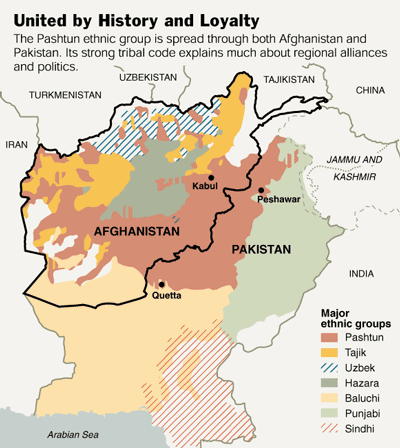
This scenario has not played out, truthfully, in Afghanistan and there is no reason to think that Pakistani tribal leaders won't do the same: take US aid and particularly, arms, then turn around and protect Al Qaeda and the Taliban. They are more Pashtun than Pakistani (or Afghani), and so are the Taliban and much of Al Qaeda in that region.

So you tell me: is blood thicker than a falling dollar?

(Crossposted to
Simply Left Behind)

Labels: , , ,

Bookmark and Share

Saturday, March 03, 2007

A major misjudgment

By Creature

A resurgent Taliban in Afghanistan. A surprise visit and a warning to do more by the vice president to President Musharraf of Pakistan. A conveniently quick arrest of a Taliban leader soon after. These were the major news stories coming out of Pakistan and Afghanistan this week, but did you know that the Taliban leader captured had already been in custody back in 2001? Did you know the United States gave their "tacit approval" of his release? I certainly did not. The Independent [UK] fills us in:

If Mullah Akhund is as central to the Taliban insurgency as now appears to be the case, the fact he was in custody as long ago as 2001 is likely to prove an embarrassment to the Americans and the Afghan authorities. When he was released under an amnesty after surrendering to the Northern Alliance, officially the US military claimed it did not know about it. But according to reports at the time, the Americans gave tacit approval.

With the Taliban insurgency looking increasingly dangerous as time goes on, that decision now looks like a major misjudgement.

How many more major misjudgments can our troops, our country, our allies, and the world at large endure?

(Cross-posted at State of the Day.)

Labels: , , ,

Bookmark and Share