Dear Allen West, how about not driving a fucking Hummer?
Labels: Allen West, automobiles, gas prices, Republicans

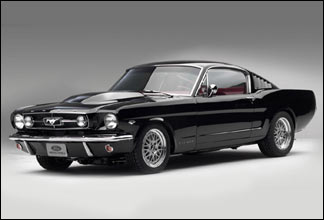
Though much of the Mustang was borrowed from other Ford vehicles, including a Falcon chassis, the car developed an identity all its own for a younger generation in search of new looks and experiences. It was designed to appeal to both men and women, had a dash of elegance copied from European sports cars, and featured a galloping steed in the middle of its grille that buyers thought was, well, really cool.
Steve McQueen was almost upstaged by the souped-up Mustang he drove in the movie “Bullitt.’’
Dr. Frey and his team created the car in just 18 months, and expectations were modest when it was introduced on April 17, 1964, at the New York World’s Fair. Ford figured it would sell 80,000 Mustangs in its first year. It sold more than a million in its first two years.
[[snip]
At his death Dr. Frey owned an original Mustang, his son Christopher said, adding that he liked to drive it fast.

At times besieged by autograph seekers for his role with the Mustang,[1] Frey had been most proud of assisting Ford in including safety improvements including disc brakes and radial tires in their lineup.[1] In 1967, TIME called Frey "Detroit’s sharpest idea man".[1]
Frey, who was assistant general manager and and chief engineer of a Ford Motor Company still suffering dry heaves over the Edsel, said he watched GM put bucket seats in the Corvair and rename it Monza, and it began to pick up with customers. There was also the dinner table motivation of his kids telling him his cars stunk.
Frey's first take on the Mustang was a mid-engined convertible in 1962 which, while working with Ford General Manager Lee Iacocca, he would develop into the car introduced to the World's Fair in 1964. When the coupe predicted to sell 80,000 units a year actually sold a million-plus units in its first two years – and then sold and sold and sold – Frey became an American legend. The rest is not just history, it's the present and the future, with the Mustang certain to be a staple in the Ford portfolio for years to come.

Labels: Auto Industry, automobiles, obituaries
Labels: automobiles, energy, gas prices, renewable energy
US carmaker General Motors is joining with scooter maker Segway to make a new type of two-seat electric vehicle.
The prototype, which will be debuted in New York, is aimed at urban driving. GM aims to start making them by 2012.
The vehicle, named Puma, can go as far as 35 miles on a single charge. It will use lithium-ion batteries.
There had been rumours in the tech press for months that Segway was poised to announce a new product that would complement its futuristic Segway Personal Transporter, which failed to capture much more than the imagination of people nationwide, likely because of its cost ($5,000) and its niche marketing ("Is it for sidewalks or streets?").Labels: auto bailout, automobiles, General Motors
When the president announced that he was giving Chrysler thirty days to work out an alliance with Fiat, the first thing I thought of was the ill-fated merger in the 1950s between two dying auto companies in the United States: Studebaker-Packard.
The circumstances are certainly different for Chrysler today, but I can't help but think that a shotgun marriage with Fiat is doomed. Chrysler has already proved it doesn't play well with others; its 1980s alliance with Mitsubishi and their ill-fated merger with Germany's Daimler are proof enough, and Fiat's reputation in the United States was tarnished by selling cheap cars that didn't hold up well on the American road; the joke was that the name stood for "Fix It Again, Tony." And it has a guilt by association with the disastrous venture known as the Yugo, which was basically a Yugoslavian Fiat.Labels: Auto Industry, automobiles
TOKYO — Toyota Motor, the Japanese auto giant, said Monday that it expected its first operating loss in 70 years, underscoring how the economic crisis was spreading across the global auto industry.
On Monday, Toyota said it expected an operating loss in its auto operations of 150 billion yen, or $1.7 billion, for the fiscal year ending March 31. That would be the company’s first annual operating loss since 1938, a year after the company was founded, and a huge reversal from the 2.3 trillion yen, or $28 billion, in operating profit earned last year.
Analysts said Toyota’s downward revision, its second in two months, showed that the worst financial crisis since the Depression was threatening not just the Big Three but also even relatively healthy automakers in Japan, South Korea and Europe. Many other companies will also soon be reporting losses.
Toyota said it still expected to report a small net profit, helped by interest and dividend income as well as tax-related savings of 50 billion yen, or $560 million.
With some $18.5 billion in cash, and relatively little debt, Toyota is still in far better shape to weather the downturn than General Motors and Chrysler, which on Friday received $17.4 billion in emergency loans from Washington.
Labels: automobiles, companies, global economy, Sign of the Economic Apocalypse
Labels: automobiles, energy, Newt Gingrich, oil, oil industry, Republicans, Sign of America's Imminent Collapse
Labels: automobiles, Islam, Japan, oddities
In my judgment, the costs and risks of continuing down the current path outweigh the potential benefits that might be achieved. Persisting indefinitely with the surge strategy will delay policy adjustments that have a better chance of protecting our vital interests over the long term.
Even if the results of military operations improve in the coming months, there is little reason to assume that this will diminish Sunni ambitions to reclaim political preeminence or Shia plans to dominate Iraq after decades of Saddam's harsh rule. Few Iraqi leaders are willing to make sacrifices or expose themselves to risks on behalf of the type of unified Iraq that the Bush Administration had envisioned. In contrast, there are many Iraqi leaders who are deeply invested in a sectarian or tribal agenda. More often than not, these agendas involve not just the protection of fellow Sunnis, Shiites, and Kurds, but the expansion of territorial dominance and economic privileges. Even if U.S. negotiators found a way to forge a political settlement among selected representatives of the major sectarian factions, these leaders have not shown the ability to control their members at the local level. After an intense year-and-a-half of bloodletting, many sub-factions are thoroughly invested in the violence. We have the worst of both worlds in Iraq -- factional leaders who don't believe in our pluralist vision for their country and smaller sub-factions who are pursuing violence on their own regardless of any accommodations by more moderate fellow sectarians. As David Brooks recently observed in the New York Times, the fragmentation in Iraq has become so prevalent that Iraq may not even be able to carry out a traditional civil war among cohesive factions.
Incredibly, cars in America today get less mileage per gallon than they did twenty years ago. Meanwhile, hybrids, plug-in hybrids, and fully electric cars are at or nearly at commercialization, yet there is not enough incentive for consumers to buy them or producers to make them on the mass scale necessary. For fiscal year 2008, the Administration requested just $176 million for new vehicle technology research -- an amount that was less than what was requested five years ago. Given that other developed nations have made great strides in improving fuel economy, this is fertile ground for rapid improvement. In fact, achievements on this front largely would be a matter of generating and sustaining political will that has, thus far, been disappointing.
Labels: automobiles, Bush Administration, Cheney, Congress, Iraq

Like a red-faced college student begging his mother not to show visitors the embarrassing old family photos, General Motors would like you to forget its early attempts at car-based crossover utility vehicles. Imagine the company wincing on the sofa as you chuckle your way through G.M.’s picture albums from the ’90s, filled with snapshots of the Pontiac Aztek and Buick Rendezvous — the vehicular equivalent of acne and braces, velour dickies and the mullet.
But after years of failing grades on the crossover exams — aced by some imports — G.M. retreated to study the segment, do its homework and cram for the biggest test yet. Crossovers are the nation’s fastest-growing class of cars or trucks.
The company has sworn off minivans entirely. It has even begun to ditch some of its old-school truck-based S.U.V.’s, like the Chevrolet TrailBlazer and GMC Envoy, that went from top sellers to bottom dwellers faster than you can say “Fill ’er up.”
With car-based crossovers outselling traditional sport utilities for the first time in 2006, American families have made it clear that the former are their preferred form of transport. Compared with S.U.V.’s, these types of tall wagons give up some towing capacity and some ground clearance for off-road use, but their advantages in handling, ride, gas mileage and refinement seem to outweigh those drawbacks for many people.[Emphasis added.]